The method of Bhaona dances are differentiated on the basis of respective Satras. These Satras are religious organisations headed by a direct descendant of a disciple of Shankar Deo. These are of mainly four types, Satras, Aoniyati, Dakhinpat, Garmuriya and Karnbahi.
Bhaona Dance is performed in accompany of a minimum of four `Khols`, where the maximum number can exceed upto sixty. As a general rule use of odd number of Khols must be prohibited. There are also pairs of big cymbals (Bhon Tals) which are used in the dance.
The dance is enacted in an open air platform made of mud in the village. Presently they are now performed under pandals or in Dangar Namghars (big Namghars). Earlier a round platform was erected surrounding which the spectators were seated. These days the platform is raised in a rectangular fashion on one side and the audience faces the stage sitting in front of it. A greenroom is also constructed from where the performers walk towards the dais.
Lights play an important role in the performance. For lighting a plantain tree is first cut into three or four pieces. Next a hole is made on one side of each piece into which mustard oil is poured. Two long wicks made of cotton are stuffed inside the hole and each one is lighted. These lights known as Bhota are placed around the stage. Torches are also used to light up the stage but there are arrangements for light for the audience. All the important personalities of the village are invited by the members of the Bhaona. The prominent people are known by the terms, Baroatui, Gaonbura, Haruatui, Mendhi, Baro-gayan, Harugayan and Gohain, (Goswaxni). Even the seats in the hall are arranged according to the grade of aristocracy. One`s position is judged by the number of plough one owns.
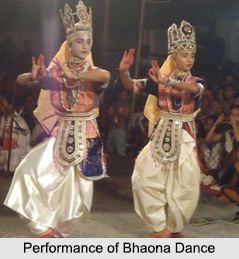
Bhaona dance is sometimes performed for many days. Villagers enjoy the performances whole night. At times even twelve dramas are staged which are known as Borokheliya Bhaona. Performers of one Satra travel from one village to another to perform dances.
Presently the dancing technique of the Bhaonas has been developed. The dance commences as a prominent person of the village narrates the audience about the history or Iti-britta of Bhaona dance through a song called `Malita.` Next Dhyamali begins, which is playing of `Khols`. Dhyamali is of two types, one that is played first is known as Horudhyamali (small Dhyamali), and the next one that is played is called Borodhyamali (big Dhyamali). Presently the Satras have introduced a third Dhyamali known as Mazudhyamali. Each Dhyamali is marked by a pause during which both the players and the singers take rest.
A group of Kirtan singers also perform during the Bhaona dance. Before Dhyamali begins, a Ghat between the singers known as Gaya and khol and cymbal players known as Bayan, takes place.
The first Dhyamali starts with slow beats and gradually the rhythm rises and then concludes with a climax. The player in the first stage jumps while playing the Dhyamali. He holds the instrument above his head and also on his sides. Sometimes he plays one side of the `Khol` is played by both the hands. The players of Dhyamalis also sing songs called `Ghosha` while pathetic songs are called `Viiap.` The later one is usually sung during occasions like the death of Abhimanyu who was Arjuna`s son. Many songs are composed in `Payar` metre while some are known as `Khama-prarthana.` The song of Khama-prarthana deals with
Lord Brahma asking for pardon from
Arjuna.
After the Dhyamalis the choreographer and director, known as the Sutradhar comes up on the stage and gives a brief description about the entire drama by singing and dancing. A Sutradhar in Bhaona is holds a prominent place and has an important role to play. Once he adopts the profession he always remains a Sutradhar. He trains few of his students his art and after his death the best pupil takes up the job.
The songs and dances performed by a Sutradhar remains the same in all the plays, the only change being made is the title and the synopsis of the drama. Before beginning the performance the Sutradhar first performs Lord Vishnu`s Aradhana (invocation of God Vishnu) and then the Dashavatara (ten incarnations of God). A Sutradhar is always present while the drama is being enacted. He is either standing on the sides of the stage on approaching in the middle of the drama to explain the gestures by narrating the complete theme. Bhaona dances are not performed by females hence even the female roles are enacted by the male performers.

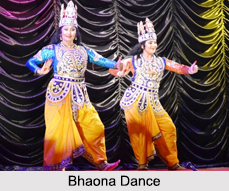 Bhaona Dance has evolved from the compositions of a "Vaishnavite" saint and a preacher named Srimanta Sankardeva. This dance- drama is purely religious and is based on the episodes of Lord Krishna"s life. The plays which were composed by Sankaradeva are known as "Ankiya" or "Anka". Bhaona Dance is usually played by both the men and women at night. The performers speak the "Brajawali" language.
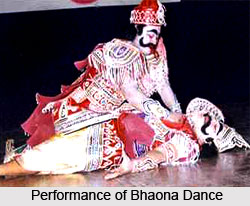 History of Bhaona Dance relates to a Vaishnavite sage and a preacher named Mahapurusha Shankar Deo. He was born in the month of Ashwin, Shukla Dashami in a village named Bordoa in Nowgong district in 1329. For 120 years he spent a saintly life preaching people about god. He left this abode in 1449. Shankar Deo`s father, Kusumbar Bhumian, and mother Satya Sandhya Devi, were from Mithila district in
 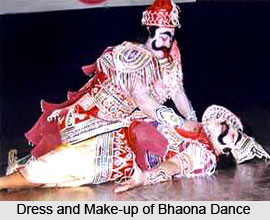 The dress and makeup during the Bhaona dance is usually very appealing. The dress of a Sutradhar who is the choreographer and director of the dance and the play is very significant. It consists of a `Ghuri` meaning Ghagra and a `Chaddar` meaning a piece of cloth crossed at his chest and hung up from both the shoulders and remains tied at the waist. The Sutradhar also wears a full-sleeved tight singlet (bundi) which remains tied at the sides by strings. He also puts on a silk turban which remains surrounded by a garland of Tulsi leaves. The colour of his dress is usually white. The Sutradhar along with all the performers wears a peculiar form of anklet termed as `Nupurs.` They are made up of thin iron or brass wires and are round in shape. Inside these wires there are round metal pieces.