People of Kerala

People of Kerala trace their origin back to Dravidians, the original natives of the land. Majority of the People of Kerala are residing in rural areas yet this state has achieved cent percent literacy rate.

The people of Kerala represent a diversity of races. While most of the Malayali people are Dravidians like the Tamil people, a large number of Aryans from North India has also settled down in the green valleys of Kerala and have become a part of the population of the state. Kerala was the major trading port in India through which Arab and Syrian traders took Indian spices to Europe. As a result a large number of Arabs and Syrians also settled down in Kerala. Till the creation of Israel, Kerala had a significant Jewish population too. The people of Kerala are distinctive and can easily be identified as a Keralite, either by looks or pronunciation or name.

According to some scholars, the Negrito element seems to be the earliest racial strain in the population of Kerala. There are also numbers of tribal people dwelling in Kerala. The major tribes of Kerala are Marati, Malamalasar, Kondareddis, Kammara, etc. The Urali tribe is the primitive artisan tribe of Wayanad district. Kurichiya tribe of Wayanad district is another prominent tribal group of Kerala. Their chief occupation is agriculture; both shifting and permanent cultivation of rice is practised by them. They also practice hunting. The Kurichiyas are matrilineal, having large matrilineal households in a cluster of huts known as Mittam under the authority of the maternal uncle. The Mulla Kurumbas differ very little in general appearance from the Kurichiyas but are patrilineal. The Proto-Australoids also came to the region long after the Negritos.
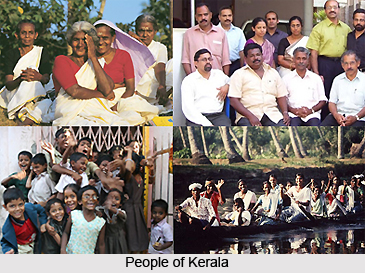
People of Kerala
The Dravidians are represented by different communities such as Nayars, Vellalas, Ezhavas, etc. The word Ezhava has been derived from Sinhala and the other name of the community, Thiya, is derived from Dwipa which means an island. Namputiris represent the spearhead of Aryan penetration to the southern region. There has been considerable mingling of Aryan and Dravidian strains in the case of Nayar community. Though there has been an infusion of Syrian and Arabic blood in the case of the Christian and Muslim communities, the basic stock is indigenous.

Kerala has the highest standard of living among all the states in the Indian alliance. Ironically Kerala has the least number of Industries or manufacturing and is entirely a consumer state. Most of the people of Kerala are Hindu. But there is a considerable population of Christians and Muslims too inhabiting the state. People of Kerala are peace loving people and they celebrate all the religious festivals. In modern times the Keralites have migrated in large numbers in search of employment to several foreign countries. The professionals of Kerala are among the most wanted experts in the fields of medicine, Information Technology etc.
Recently updated articles in States of India

History of Thissur District
History of Thissur District Thumbnail

History of Thissur District

Early History of Thissur District explains flourishing of the port cities. Now these port cities are transformed into archaeological sites.

Tippi Orchid Research Centre, Arunachal Pradesh
Tippi Orchid Research Centre, Arunachal Pradesh Thumbnail

Tippi Orchid Research Centre, Arunachal Pradesh

Tippi Orchid Research Centre in Arunachal Pradesh is renowned for its rich collection of exotic and endangered orchids. Surrounded by lush rainforest...

Tourism in Nashik District
Tourism in Nashik District Thumbnail

Tourism in Nashik District

Pilgrimage tourism in Nashik district involves visiting the various places of Hindu and Jain worship located here. Some of the holiest sites for Hind...

Mangadu, Kerala
Mangadu, Kerala Thumbnail

Mangadu, Kerala

Mangadu in Kerala’s Kollam district is a significant megalithic site known for its urn burials, cist burials, menhirs, and stone circles. Excavations...

Devaswom
Devaswom Thumbnail

Devaswom

History of Devaswom is not very ancient and can be dated back to late seventeenth century.