
Patna Crisis
Patna Crisis seemed to be a knotty one, with native nawabs eluding the British forces successfully.

Share this Article:

Patna Crisis, 1762-1763, British IndiaIn the months of December 1762, Vansittart negotiated a new agreement with Mir Kasim, Nawab of Bengal, regarding duties (the system of taxing on goods) on English private trade. They agreed to a rate of nine per cent tax. If any disputes were to arise, native officers of justice were to reconcile the issue. The Bengal Council however, absolutely rejected Vansittart`s agreement.

On 15th May 1763, on behalf of the Company, Peter Amyatt (d.1763) met Mir Kasim at Monghyrl for fresh trade talks. Here, Peter showcased a new plan calling for free trade, excepting a two and a half per cent tax on salt. On May 26th, Mir Kasim rejected this plan downright.

On 24th and 25th June, aware of Mir Kasim`s approaching troops, William Ellis (d. 1763), the Company Agent at Patna, seized the city. Ellis was forced out just as quickly by the Nawab`s troops. At the nearby Company factory, approximately 170 Europeans and 1200 Sepoys surrendered to Mir Kasim`s troops led by Markar and Sumroo.

On 10th June, Major Thomas Adams (d. 1764) with a force comprising 1000 Europeans and 4000 sepoys (soldiers) headed for the upcountry in Patna. This force captured Kutwa on June 19th and took Murshidabad on June 24th. On 3rd July, Mir Kasim ultimately nabbed Amyatt and his party. Amyatt had previously been detained at Murshidabad. Kasim seized the chance to slaughter the English entirely.

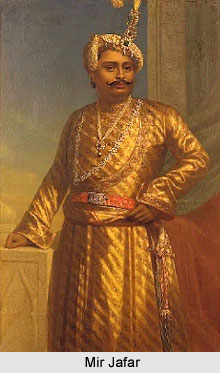
On 8th July 1763, in response to the news from Patna about the terrible crisis, the Bengal Council announced the restoration of Mir Jafar as the Nawab of Bengal.

On 10th July, the Company executed a treaty with Mir Jafar. The treaty provided for free trade, with the exception of a two and a half per cent tariff on salt and for damages caused by Mir Kasim to Company property or persons. The Company also obliged Mir Jafar to maintain an army of 12,000 foot and 12,000 horse. The treaty also stated that in future, only the English would be allowed to construct fortifications.

On 5th October, Mir Kasim prepared for an even more ruthless reply to the British. He ordered the slaying of all English prisoners at Patna which numbered about fifty. On 6th November, Adam`s force stormed and captured Patna, but Mir Kasim escaped to Oudh. Patna crisis seemed to intensify further, with none of the battling parties trying to arrive at a conclusion.

In February, the elections for the East India Company`s Court of Directors and its Chairman embraced the struggles of Laurence Sullvan (c.1713-1786) and Robert Clive for the dominant influence in the making of Company policy. The Company policy, on this occasion was won by Sullvan. Their dispute focused on the level of severity of terms in the Treaty of Paris ending the Seven Years War. In the long term, their struggle impacted the development of Company policy in India. The struggle would drag into the fray the attention of Parliament.

On 10th February 1763, Great Britain and France signed the Treaty of Paris ending the Seven Years War. Article eleven of the treaty laid out the restoration in India of the French colonial possessions of Pondicherry and Chandannagar.


Share this Article:

Related Articles

More Articles in History of India


History of Uttar Pradesh
The state was the heart of Mahabharata war and the history of Uttar Pradesh is very much the history of India. The place finds its mentions in Hindu epics Ramayana and Mahabharata.
History Of Archaeology In India
History of archaeology in India contributes a lot to define the past history and the social life of India.
Mughal Architecture during Babur
Mughal architecture during Babur marked the foundation of a new architectural era in India, blending Timurid, Persian, and local influences. His reign emphasized garden design, notably the Charbagh layout, and modest yet elegant structures. As the first Mughal emperor in India who introduced this architecture during 16th century Babur’s creations reflected symmetry, functionality, and a deep appreciation for nature.
Princely State of Patdi
The Princely State of Patdi was one of the many princely states under the British Raj, ruled by local Kadva Patidar leaders under indirect British control. Known for its strategic location near the Little Rann of Kutch, Patdi played an important role in salt production and regional trade. Princely State of Patdi or Patri was incorporated as a part of the Baroda Agency, which was a sub division of Western India States Agency.
Architecture during Sayyid and Lodi Dynasty
Architectures during the Sayyid and Lodi dynasty were mainly the tombs and monuments for the dead rulers. It were carefully designed and meticulously constructed.
Brahmanical Sources of Ancient History
Brahmanical Sources of ancient history are contained in the Vedas and they constitute one of the most important literary sources of information about ancient India.
Female Education In British India
The over brimming enthusiasm among zealous Hindu reformers welcomed female education in British India.
Revenue System of Mauryan Empire
Revenue system of Mauryan Empire can be divided into eight categories. The principal revenue of the state was the land revenue, taxes from traders, artisans and professional taxes were also collected.
Mughal Architecture During Jahangir
Mughal architecture during Jahangir`s period was relative dull in comparison to that of Akbar dynasty.
Princely State of Satlasna
Princely State of Satlasna was amongst the former native states of India that was appointed as one of the Indian princely states during the early 19th century.
Coins of Chola Empire
Coins of Chola Empire were issued in gold, silver and copper and carried the Chola emblem.
Social Life during the Pala Period
Religious toleration and simple living were the characteristics of social life during the Pala period.
Coins of the Chalukya Dynasty
Coins of the Chalukya Dynasty was reintroduced in the South India after a brief break of coinage less period of nearly three century. Chalukyas issued coins only in gold and they exhibit a brilliant artistic skill of the engraver.
Costumes of Indus Valley Civilisation
Costumes of Indus valley Civilization have been considered as the basis for Indian clothes. Sophisticated ornaments and make up were used during that age.
Development of Science under Gupta Empire
Development of Science under Gupta Empire was progressive and it had attained considerable perfection. Mathematics, astronomy, medicine, chemistry, physics and metallurgy were the most prominent of the sciences at that time.
Culture under Delhi Sultanate
Culture under Delhi Sultanate had enduring aspects to it. It included the society, the religious condition, literature and art and architecture of that period.
Princely State of Hapa
Princely State of Hapa was incorporated as a part of the Baroda Agency, which was under the administrative control of the Western India States Agency.
Economy Under Chola Dynasty
Economy under Chola dynasty was strong and well developed. The economic life of the people of the Chola Kingdom was well balanced with their social life.
Coins of Khilji Dynasty
Coins of Khilji Dynasty had an influential feature that was followed by the other dynasties.
Religion During Mauryan Dynasty
Religion during Mauryan dynasty became a considerable episode in Indian history with an esteemed lineage of rulers.






