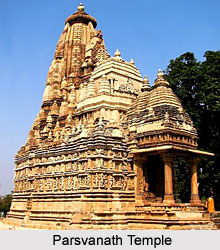
 Parsvanath Temple was built in the tenth century. It is marked by the picturesque sculptures and curvatures which decorate the walls of the temple. It is one of the largest Jain temples that are included among the Khajuraho group of temples. It is located in the Bundelkhand region of Madhya Pradesh. In spite of being a Jain temple the Parsvanath temple shares the sculptures and architecture of Hindu temples of Khajuraho. The temple is carved with sculptures that depict the art of 9th century to 13th century.
Parsvanath temple is one of the largest Jain temples dedicated to the first of the Jain Tirthankaras. Originally it was dedicated to Jain God Adinath who was represented as a bull. This was later replaced by the statue of Parsvanath which was established in the temple in 1860. Since then the temple came to be known as Parsvanath Temple. Although this temple is considered as one of the largest Jain temples in India, it is decorated with the majestic Hindu sculptures which depict the ancient Chandela art. It also has graceful figures of apsaras.
This is the largest of the Jainist temples in the southeastern group of the temples of Khajuraho. It is also one of the finest in the total temple complex. Measuring 65.6` by 36` (20m x 11m), it lies within a walled enclosure and is noted for the precision of its construction and its beautifully sculpted figures. The temple has a solid outer wall embellished with three bands of graceful sculptures depicting Hindu Gods (despite its affiliation as a Jain temple). More figures can be found on the outer face of the sanctum, depicting `apsaras` (heavenly nymphs) in a variety of poses. The temple was originally dedicated to the deity Adinath, but in the late 19th century an image of Parsvanath was installed there and the temple assumed this new name.
The temple is oblong on plan with axial projections on the two ends; the projection on the east or front constitutes the entrance-porch, while that on the west consists of a shrine attached to the back of the sanctum. It is a sandhara temple; the transepts with the balconied windows are absent. The outer wall is solid and is decorated with three bands of graceful sculptures. The entrance-porch shows an ornate ceiling of coffered design with pendants, the central one being exquisitely embellished with chain and floral patterns, terminating is a pair of intertwined flying vidyadhara figures. The interior consists of a sanctum that is enclosed by ambulatory a vestibule and maha-mandapa provided with a doorway. The door-lintel of the maha-mandapa represents a ten-armed image of yakshi Chakresvari riding on Garuda, while that of the sanctum shows Jinas. The Parsvanatha temple resembles Lakshmana temple in voluminous modelling, proportion and poise.