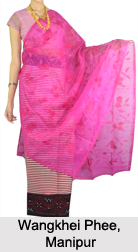
 Textiles of Manipur encompass those of the valley where the bulk of population are the Meitheis, who believe that the art of weaving was taught to them by their deity Panthoibi during mythological era, when the goddess learnt the art from the spiders who were weaving their cobwebs. Given a female deity introduced weaving, all the weavers in Manipur are women. Other speculations include the story of the princess Thoibi of Moirang principality, who after being deported to Kabow valley learnt the science of sericulture and silk weaving which she introduced in Manipur upon return. Perhaps this is why bulk of silk weavers is still referred to as Kabo weavers.
Weaving in Manipur has evolved from the traditional simple back strap type loom otherwise known as Loins loom or Indonesian Tension loom, to throw shuttle looms and subsequently to fly shuttle looms, with simultaneous introduction of various design gadgets like draw boy or dobby, and even Jacquard along with original design concepts. However, discontinuation of spinning, ginning etc. to large extent became a reality in the state just like the rest of India, due to gradual development of mill made yarns. Of course, there are exceptions.
Meitheis, the largest community in Manipur, have hand spun and hand woven cotton fabric as a facet of their traditional ritual, say their principal festival Lai Haraoba, when the traditional priests and priestesses (the Meibas and Meibis) not only use hand spun and hand woven fabrics but also those who participate in the procession. Spinning of cotton thus continues even today and the spinning wheel or "Tareng" is still the household implement. There are few places like Khonjam and Kakching, known for high quality hand spun yarn. Perhaps, Manipur is the only state where Tareng or Charkha is today being sold as an essential implement.
Silk and Sericulture have their own stories for their origin in Manipur. As per Major W. McCulloch, the art of silk and sericulture originated in the land and later went to China where it started spreading elsewhere. Another story says silk was introduced in Manipur about 600 years back during the rule of King Khangemba, who is said to have had defeated the Chinese army and took few Chinese soldiers as war prisoners, allowing them to settle in Kamen, a Loi hamlet. Many of them were believed to know the art of sericulture and technology of silk textile that they introduced in their settlement. Since they married various Loi girls, the technology percolated to the Lois. This is perhaps why sericulture is still practiced in Loi villages such as Laimram, Sekmai, Khur Khul and Kakching. Another legend is the story of Princess Thoibi. Traditionally, the Lois and the Meitheis used to rear Mulberry and Eri worms reel and spin yarn from cocoons, producing various fabrics as per the demand. When the Meitheis were Hindunised, they considered reeling of worms as low caste job, thus discontinued leaving Lois to continue with it. Rearing of Tassar worm however was introduced in the hills as part of Government programmes, as subsidiary occupation of various tribes, using Oak as feed plant. It is yet to be established as a successful economic occupation.
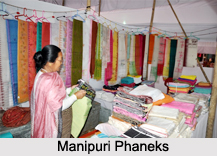
Be it the hills or the valley, the indispensable facet of weaving in Manipur are women. Textile operation from beginning to end is basically the affairs of women and men have no entry. It is said, a girl who does not know weaving cannot get her match for conjugal life. A loom is certainly a proud possession of a woman of Manipur, irrespective of the community she belongs.
 The
The  Apart from the Phanek, one of the wonder