Introduction
Textiles of Manipur encompass those of the valley where the bulk of population are the Meitheis, who believe that the art of weaving was taught to them by their deity Panthoibi during mythological era, when the goddess learnt the art from the spiders who were weaving their cobwebs. Given a female deity introduced weaving, all the weavers in Manipur are women. Other speculations include the story of the princess Thoibi of Moirang principality, who after being deported to Kabow valley learnt the science of sericulture and silk weaving which she introduced in Manipur upon return. Perhaps this is why bulk of silk weavers is still referred to as Kabo weavers.
Weaving in Manipur has evolved from the traditional simple back strap type loom otherwise known as Loins loom or Indonesian Tension loom, to throw shuttle looms and subsequently to fly shuttle looms, with simultaneous introduction of various design gadgets like draw boy or dobby, and even Jacquard along with original design concepts. However, discontinuation of spinning, ginning etc. to large extent became a reality in the state just like the rest of India, due to gradual development of mill made yarns. Of course, there are exceptions.
Meitheis, the largest community in Manipur, have hand spun and hand woven cotton fabric as a facet of their traditional ritual, say their principal festival Lai Haraoba, when the traditional priests and priestesses (the Meibas and Meibis) not only use hand spun and hand woven fabrics but also those who participate in the procession. Spinning of cotton thus continues even today and the spinning wheel or "Tareng" is still the household implement. There are few places like Khonjam and Kakching, known for high quality hand spun yarn. Perhaps, Manipur is the only state where Tareng or Charkha is today being sold as an essential implement.
Silk and Sericulture have their own stories for their origin in Manipur. As per Major W. McCulloch, the art of silk and sericulture originated in the land and later went to China where it started spreading elsewhere. Another story says silk was introduced in Manipur about 600 years back during the rule of King Khangemba, who is said to have had defeated the Chinese army and took few Chinese soldiers as war prisoners, allowing them to settle in Kamen, a Loi hamlet. Many of them were believed to know the art of sericulture and technology of silk textile that they introduced in their settlement. Since they married various Loi girls, the technology percolated to the Lois. This is perhaps why sericulture is still practiced in Loi villages such as Laimram, Sekmai, Khur Khul and Kakching. Another legend is the story of Princess Thoibi. Traditionally, the Lois and the Meitheis used to rear Mulberry and Eri worms reel and spin yarn from cocoons, producing various fabrics as per the demand. When the Meitheis were Hindunised, they considered reeling of worms as low caste job, thus discontinued leaving Lois to continue with it. Rearing of Tassar worm however was introduced in the hills as part of Government programmes, as subsidiary occupation of various tribes, using Oak as feed plant. It is yet to be established as a successful economic occupation.
Be it the hills or the valley, the indispensable facet of weaving in Manipur are women. Textile operation from beginning to end is basically the affairs of women and men have no entry. It is said, a girl who does not know weaving cannot get her match for conjugal life. A loom is certainly a proud possession of a woman of Manipur, irrespective of the community she belongs.
Textiles of Meitheis of Manipur
Meitheis are the largest group of people in Manipur. Major W. McCulloch reported on their attire that the men dressed in the same way as those in the rest of the country; but the Manipuris far surpassed the others in the cleanliness of their garments. Various articles of dress and ornaments could not be worn unless it was permitted by the Raja, which was much coveted. Persons of high rank were permitted to have carried before them a red woollen cloth and a cloth of cotton manufacture. These they used as rugs to sit on which are prized; as dresses they could be used by any who could afford them. The women attire was quite different from that worn by the rest in the country, consisting of a stripped cotton or silk cloth passed round the body under the armpits and over the breasts, a jacket and a sheet.
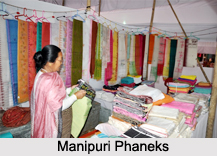
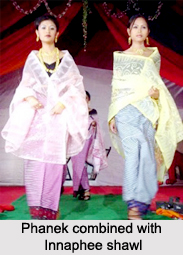
Another scholar Dr. R. Brown reported in more detail on the attire, stating the men"s dress did not differ materially from that of the Bengalis, consisting of a dhoti, kurta or occasionally shirt, and a "chudder" or sheet. In winter, those who could afford wore a quilted and padded coat generally having long uncomfortable sleeves and enormously high colours. Shoes were seldom worn. Their "pugree" was shorter than that worn by Hindustanis, but put on in same manner. Women"s dress, when of good quality, was picturesque and pleasing. During the hot weather, it consisted of a piece of cloth open except at the bottom, where it is stitched together by the edges for a few inches; it was folded round the body, under the armpits and over the breasts, and tucked in by the hand at the arm. In length it reached the ground, but hitched up half way to the knee for walking, and tucked in again at the waist. This piece of cloth is called "Phanek", wide enough to go one and a half times round the body, giving enough room for the legs to walk. It is made in cotton and silk and only patterns and stripes of various colours and widths run across the material, the ground work being of different colours. The commoner patterns are red with green stripes, green and black, blue with black and white stripes, yellow and brown, dark blue with green and white stripes etc. At the top and bottom of the garment is a broad margin where geometrical figures are sewn by hand with multicoloured floss silk. Over the Phanek was worn a white sheet, folded in usual native manner, the face being left uncovered. In the cold season, a short jacket with long sleeves was worn, reaching below the bust over the Phanek, fitting tight, the material being usually velvet or satin, black, blue or green the favourite colours. Girls until puberty or near wore the Phanek round the waist, the upper part of the body being bare. The white sheet worn over the Phanek, called In-na-phee, is beautiful white muslin either plain or embroidered with white thread.
The style of wearing Phanek by many modern Meithei women has undergone change in past few decades, with the adoption of Assamese Mekhala style by using a 2.5 metre long half saree over a modern blouse. The older style continues amongst rural women in villages and the Lois. The style of Panggens (Muslim Meitheis) is slightly different both in respect of combinations and wearing style. Phaneks are woven out of hand spun yarn, dyed in various colours and then woven in either throw shuttle or fly shuttle looms. The embroidered designs are brought out with dobby. However, nowadays coloured mill yarns are used. In-na-phee was woven out of hand spun yarn mostly around the great Loktak Lake, spinning and weaving of finer cotton requiring humid climate. Coarse sheets made out of hand spun yarn with the help of Tareng are popular bed spreads and body covers in winter as well as shawls. They are made from short staple cotton grown by the Meitheis, the Lois or the tribes. The tradition still continues along Imphal-Morey-Tamu highway. Often yarns are dyed in various colours to produce shawls of different designs.
Textiles of Naga Tribes of Manipur
The Naga tribes of Manipur have similar textile technology and culture to the Naga tribes of Nagaland, though there are differences in design. One of the well known Naga tribes of Manipur is Rongmei Naga, often referred to as Kabui. They have similarity with the Zeme and Liamgmei Nagas of Assam and Nagaland, together known as the Zeliangrong Nagas. Like any other Naga tribe, the Rongmeis also used to grow short staple cotton, spinning them with drop spindle or spinning wheel and weaving fabrics with Loins loom. However, their ginning method is rather better than their cousins, which they have supposedly learnt from the Mizos and the Kukis. They also used nettle fibre as raw material for their textile products. Their traditional costumes were simple yet beautiful, which however have undergone considerable changes as they also switched over to mill made yarns as their cousins.
Amongst the other Naga tribes are the Maram Nagas, living close to the Manipur-Nagaland border almost on the Imphal-Kohima national highway. They are considered one of the quasi-Angami tribes, owing to their similarity with the Angami Nagas that also encompasses the textile technology adopted by them. The ordinary dress of a Maram Naga consists of a short black cotton kilt ornamented by three or four rows of white cowries, or in these days white trouser buttons. A white cotton rug thrown over the shoulders completes the costume. The Mao Nagas are another quasi-Angami tribe who only inhabit the boundary of Nagaland and Manipur, again obviously bringing considerable influence of the Angami styles and designs. They are further subdivided into various sub-tribes like Merni and Paomata, who also maintain their separate identity though the textiles and dresses are more or less identical. Their ordinary costume is again the same as the Maram Nagas.
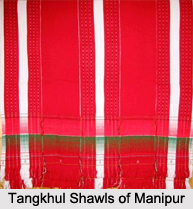
The Tangkhul Naga tribe found settled in the Ukhrul district of Manipur are considered to be one of the exceptional tribes among the Nagas in many ways. It is the only tribe having features of both Mongoloid and Aryans, which makes them one of the most handsome people of the east. Traditionally, the Tangkhuls are divided into eight regional divisions: North Raphei, Northeast - Somra, Southeast - Kaikhang, East - Ram, South - Kamao, West - Kharao, Southwest - Kharei and Northwest - Kharas Raora. People of each division are supposedly experts in a particular skill, product of which is consumed by the entire tribe. The Kharaos are the expert weavers and even today they produce the bulk of cloth used by the Tangkhuls. They use the technology almost identical to all the other Naga tribes, which has also undergone identical changes. Their designs of fabrics whether shawls, wrappers or petticoats, are exquisite. Dull or bright red shawls embroidered with white threads are one of the popular Tangkhul shawls of Manipur.
Textiles of Kuki Tribes of Manipur
The Koren or Quoireng tribe is one of the old Kuki tribes living close a few other such tribes and the Maram Nagas. Textile technology is identical to both, with influence of the designs of Angamis, old Kukis and Meitheis on their designs. Men wear the short black kilt in the custom of their neighbours, the Angamis with whom they share trade relations. Women petticoats are of various kinds, a popular one being striped like the Meithei Phanek, but border embroidery being akin to the Kuki designs. They are all woven at home.
The Anal tribe, found settled in the south-eastern part of Manipur, are also part of the old Kukis, though they consider themselves as one of the Naga tribes. Along with the Moyons, Monsangs, Koms etc., they call themselves as the Pakan tribe. Culturally and linguistically, they are close to Lushei-Kuki-Chin group of tribes though the influence of Naga culture cannot be ruled out completely. Due to long subjugation, there is also influence of the Meithei culture. The folk stories related to their origin are identical to those of the Mizos and the Kukis. Their textile technology is basically similar to those of the Nagas, Kukis and Mizos who used to spin yarn from locally grown short staple cotton with drop spindle or spinning wheel, dye the yarn with locally available vegetable dyes and weave fabrics with the Loins loom. Like their cousins, their designs have undergone identical changes, discarding the traditional spinning and dyeing technology but continuing with same old weaving technology using coloured mill yarns.
The new Kuki group of tribes, such as Thadou, Gangte, Paite, Poi, Lushei and other Mizo tribes, are comparatively recent migrants to Manipur who are found settled mostly around Churachandpur and a few select hamlets almost all over Manipur. Out of all these tribes, Thadou is demographically the biggest and their textile technology is identical to those of Nagas and other Indo-Mongoloid tribes of the region. They used to grow cotton of short staple length in their fields, sundry them after harvesting, gin them either by hand picking or by simple hand operated gins, convert them into sliver by rolling over a thin stick of grass, spin into yarn with the help of drop spindle or spinning wheel, dye the yarn with vegetable dye and finally weave beautiful fabrics with the help of the back strap Loins loom. The changes that have taken place in the past few decades are also identical, with cessation of almost all preliminary operations, preserving only weaving which is done with mill yarn of various colours with the help of Loins loom. The embroidered designs on the fabrics of Thadous, Gangtes, Mizos including Lusheis and other Kuki group of tribes are one of the most beautiful and rarely seen art works. The design and colour matching of the fabrics of these groups of new Kukis are found to be more attractive than that of their cousins, the Nagas and the old Kukis. The fabrics produced by the Mizos are called Puans, the different designs of which are more or less identical amongst almost all Mizo-Kuki groups, with minor local variations. The development of technology and design among the Mizo Kukis are gradual, thus a great lot of variation has been noticed.
Other Textiles of Manipur
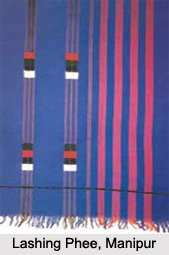
Apart from the Phanek, one of the wonder textiles of Manipur is Lashing phee (Lashing = cotton; phee = cloth), so named since it is a needled textile stuffed with cotton slivers. It is usually woven either with Loins loom or throw shuttle loom. Cotton sliver is introduced alternately in weft on which warp runs creating a thick stuffed fabric with wavy surfaces. Depending on the colour of yarn used, Lashing phee of different designs are produced. The textile is usually made either by the Meithei or the Loi women, settled in Manipur or elsewhere. However in quality and design, Lashing phee of the Lois are considered to be the best, particularly the fabric produced by the Lois of Fayang village being most famous.
Silk and sericulture is still being practised by the Lois of few select hamlets, who could develop silk fabrics of various designs. One of the well known designs of silk fabric produced by the Lois of Laimram village is Moirang phee. As the name suggests, it was a type of cloth specially designed for the royal women of Moirang particularly. Later, perhaps when Manipur (or Meithei Laipak) was brought under the rule of a king of Ningthouja clan, the costume became common to all. It is said that this dress was first worn by the mythical princess of Manipur, Thoibi. It is more or less a typical Phanek, only temple like designs above the embroidered border which are made with block printing.
Production of Muga silk is reported only in the Jiribam town near Assam border, perhaps because of influence of the neighbouring state. However, Manipuri Muga is inferior to that of Assam, certainly not as good as the one produced in the Sualkuchi town of the Kamrup region. Kameng Chatpa is a white cloth with purple patterns of scrolls stamped on it by means of wooden blocks, which are said to have been introduced by the Chinese merchants who visited Manipur during the reign of King Khagemba around 14th or 15th century. During pre independence era when the state was ruled by the feudal kings, the cloth was not worn by persons of inferior rank and only the Rajkumars were permitted to use it at their pleasure. The same privilege was later extended to the sons-in-law of the king. After independence, however, it was extended to commoners with the impact of democracy.
"Phee-gu-napu" is an orange coloured cloth which was meant for the persons of higher class before independence, but later became open to public. "Ju-gi-mairi" is a red coloured cloth which was worn in the presence of the king, by those who held titles of office as members of the "chirap" or by the favour of the king. It was open to public as well in earlier times, but in absence of the king. "Gulap machu" is a rose coloured silk cloth of pretty pink shade, worn by privileged persons who held office or enjoyed the royal favour but was open to public only if used in absence of the king. It is now freely open to public.
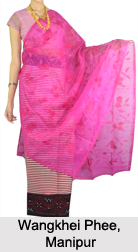
Wangkhei is a small cluster close to the capital city Imphal. Traditionally, women of this cluster were known for dyeing yarn or cloth. But subsequently, they developed design weaving and created a niche in the market. Being close to the capital city, this cluster has an advantage to interact with the designs of other states and thus create a new wave. There are designs identical to the Jamdani of Bengal, where patterns are created by a brocading technique. There are also traditional Meithei designs and often two designs are mixed together to bring new motifs. These cloths are known as Wangkhei phee and are today extremely popular. They make cloths of two and a half metre length worn over the Phanek and over five meters long worn as sarees, depending on the market demand.
The Meithei weavers also weave beautiful bed sheets, bed covers, curtains etc. with the help of cotton yarn with typical floral and geometrical designs. They also make scarves as winter garment or simply as fashion, with typical design for which they use draw boy or dobby and jacquard. There are a few hamlets famous for this type of textile goods, namely Kakching, Bamdiar, Bishnupur, Thoubal and so on. Use of turban or "pugree" has been discontinued since last few decades due to influence of modernisation, but was used commonly as a symbol of status. Pugrees with silk patterned ends were used by the descendants and relatives of the King, and by those whom it was conferred upon as a mark of favour or distinction. No one was permitted to wear turbans with silk border in presence of Kings. Lam Khong Poak with a turban with projected front was used by wrestlers and runners when performing in public. Faicharang, a cap worn by the ladies of high rank, is first mentioned in 1746 AD when the queen of King Pamheiba donned it at a dancing party of the Chothe Nagas in their village.
Even mosquito nets made and used by the Meitheis are unique, each of them embroidered beautifully with various colours, thus making their bedrooms well decorated. Thus, mosquito net production is in itself a craft and these products are even often exported from the state.