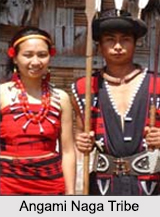
 Angami Naga Tribes are found in the Jotsoma village of Kohima district, Nagaland. According to the Angamis, their native place was Myanmar. Their ancestors migrated from Myanmar to Nagaland in Mao village. Thereafter, they advanced to Kohima district and were divided into three groups and migrated to different places of Nagaland. They are also one of the recognised ethnic groups in the state of Manipur.
Origin of Angami Naga Tribe
The Angami Nagas belong to the Mongoloid race. Angamis were divided into Kepezoma and Kepepfuma. According to a legend, they descended from two brothers who came up out of the earth. Angami Nagas were traditionally warriors.
Language of Angami Naga Tribe
"Tenyidie" is the most common language spoken among the Angami Nagas in Nagaland. They do not have a script of their own. Nagamese language has become the spoken language which has originated with the combination of Assamese, Bengali, Hindi and Nepali languages.
Society of Angami Naga Tribe
Nowadays monogamous marriages have been accepted though the males are free to marry more than one woman. Cross cousin marriage is rampant among the Angami Naga tribes. The role of the women is imperative to the society as they are the main source of income. Among the Angami Nagas, youth dormitory is known as "Morung". “Lkhuichi†is the name of the dormitory of the boys while girl"s dormitory is known as “Lloichiâ€. Morung has vanished due to the impact of Christianity. The Angami society is patriarchal and patrilineal. Youngest son inherits the maximum amount of land and other properties and other male children are given a share in the property required for their living.
 Administration of Angami Naga Tribe
Each village has a village council which consists of 7 elder members who are elected by the villagers. "Gaon Burha" is head of the council. The elected members are recognised by the Nagaland Government.
Occupation of Angami Naga Tribe
Angami Naga Tribes are agriculturists. Shifting or Jhum cultivation is practiced among this tribe. Animal husbandry has also become one of the basic occupations. They follow traditional economy and depend upon land forests. Besides this they engage themselves in weaving, black smithy and other handicrafts to meet their daily requirement during off season. Weaving is a developed traditional household industry. Women are the expert and skill weavers. The Angamis are skilled in handicrafts like bamboo works, cane works, wood works and pottery and so on.
Religion of Angami Naga Tribe
Most of the Angami Naga tribes have accepted Christian religion. Christianity has brought about tremendous change in their life. Those Angamis who have not converted to Christian religion follow a different lifestyle.
Culture of Angami Naga Tribe
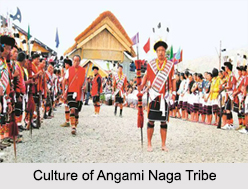
Dance and songs are an essential part of the Angami Naga tribes. On every religious and social occasion, the villagers gather together to sing and dance. Dance and songs are associated with the expression of joy after the agricultural activities, for a good harvest, on the success of hunting expedition, expression of joy in festivals. There are other dances like spear dance, bamboo dance and harvest dance. Harvesting dance is a dance which is celebrated in three days. Different songs are sung mostly historical, warring, romantic and seasonal events.
Costume of Angami Naga Tribe
The design of the clothes worn by the Angami men and women are quite different from each other. Men wear shawls called white "Mhoushu" and the black "Lohe". The women wear "Mechala" – the wrap around skirt and shawls of unique designs and patterns. Both men and women enjoy wearing beautiful ornaments.