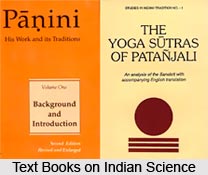
Sanskrit Scientific Literature

Sanskrit Scientific Literature is a volatile source of incessant knowledge. It comprises of compositions based on Astrology, Physiognomy, Palmistry, Mathematics, Gemmology, alchemy, medicine and others.

About Sanskrit Scientific Literature

Sanskrit Scientific LiteratureSanskrit Scientific Literature is quite extensive and elaborate on diverse subject matter. Evidence proves that Indian had made progress in the fields of scientific and technical knowledge. The contribution of ancient India was not negligible. The iron pillar of Delhi 4th century and two other pillars found in Dhar and Mount Abu are good examples. In the Rig Veda and Vajasaneyi Samhita references have been made to mechanical devices or yantras.

In India literature of alchemy survives in the forms of Kakacandesvari-mata Tantra and Svarna Tantra mentioned by Alberuni. Earliest available work is perhaps Rasa-ratnakara that was composed in 7th or 8th century A.D.

Ancient writers include Patanjali, Vyadi, Vasudeva, Charaka, Susruta and Harita amongst others. The earliest work Rasaratnakara is attributed to Nagarjuna who belongs to the 8th century a.d. Rasendra-chudamani is a literary work onmedicine compose by Somadeva 12 or the 13th century A.D. and Rasa-kaumudi by Madhava 15th century amongst others.

Medicine is divided into eight main branches - satya-tantra or major surgery, salakya-tantra or minor surgery, kaya-cikitsa or therapeutics, bhuta-vidya or demonology, kaumara-bhrtya or pediatrics, aganda-tantra or toxicology, rasayana or elixirs and vaji-karana or aphrodisiacs. Subjects like Anatomy, embryology and hygiene were known from Vedic times.

Charaka Samhita is the earliest extant work on medicine by Charaka in the 1st century A.D. The book deals with anatomy, embryology, dietetics, pathology and many other topics. Sushruta is another masterpiece. Vagbhata is another writer who wrote on medicine. His work covers all the eight sections of Ayurveda.

Human anatomy is referred to in the Atharvaveda and Satapatha Brahmana. Pathology - The earliest work in the field of Pathology is Rugviniscaya by Madhavakara in 7th century. In Paediatrics the well-known work is Kumara Tantra that has been ascribed to Ravana. The Science of the Pulse has been treated as a separate discipline in Nadi-vijnama by Kanada and a work Nadipariksa credited to Ravana. The Indian Puranas associate the names of Salihotra, Nakula and Palakapya as far as works on Veterinary Science are concerned. Literary compositions, such as, Ratna Shastra by Agastya and Ratna-pariksa by Buddhabhatta deal on gems.Vedanga Jyotisa and Atharvana Jyotisa related to the Atharva Veda emphasize on Astrology.

The science of Physiognomy and palmistry are dealt in the Vishnudharmottara, the Agni Purana and a number of other Puranas as well as in the Brihat Samhita has been dealt with. In the Bhavisyottara Purana also there is a chapter on palmistry.
Origin of Sanskrit Scientific Literature

Origin of Sanskrit Scientific Literature has witnessed fissures in various development schools and desire for specialization. The Vedic period saw the development of sacrificial schools, which preserved the ancient tradition of the Vedas. The grammar of Panini is a proof that there existed a grammatical school which desired to include in its work usages of different Vedas and different schools of the same Veda. The Vaiyakaranas are the direct associates of the science of Grammar in classical times. The Nairuktas were influenced by the necessity of the writers of Kavya who required collections of words that would help in composing their poetry.

Another early development within the Vedic period was building schools of Law that also includes religious and civil and criminal law. The Manu Smriti assumes a considerable period of development during which professional schools arose. However slowly within these schools developed a separation.

In another field of learning we can clearly see the development of expertise. The Vedic sacrifice demanded a rudimentary knowledge of the calendar and elementary conceptions of measurement. From these beginnings developed a wider geometrical, astronomical, and astrological science which is found under the comprehensive title of Jyotisha and studied in distinct schools. Medicine appears in Atharva Veda and was fostered by the schools of magic practices which produced a literary work as the Kausika sutra.

The Vedic schools had a tendency to mysticism also which is seen in the Aranyakas and the Upanishads. The Upanishads in origin is connected with Vedic schools but their ideas unavoidably transcend the school limit. Theology and theosophy with the gradual transformation of the Vedic system passed beyond the sphere of the old schools. Genetics occupied the attention of sages of these schools.

The study of metre was encouraged by mystic importance attached in Vedic times to the metre of the sacred texts. Chandas, metrics, is considered as one of the six Vedangas, but its importance and character were affected by need of affording guidance to writers of Kavya and other forms of literature. Poetics represents an independent secular science. However there is no doubt of the dominant influence of religion on the growth of Sanskrit scientific literature.

Characteristics of Sanskrit Scientific Literature

The assertion on use of nouns, elimination of verbs, significant employment of particles and case relations coupled with usage of long compounds sum up the Characteristics of Sanskrit Scientific Literature. The style of the Bhasyas underwent a clear development. Sankara is more advanced than the Mahabhasya on the grammar of Panini or the Bhasya of Vatsayana on the Nyaya Sutra. In a technical subject-matter compounds are used rigidly in order to be clear in sense. The Sutras have had a serious effect on all future work. They are regarded as definitive that does not need alteration, checking development in the substance of the science.

The formal Sutra style never grew out of date and it is predominant in Grammar. It appears in the leading work on Metrics and was often adopted in Poetics. The Bharatiya Natyashastra contains reminiscences of the Sutra style. In philosophy profound thoughts are interrupted by scholastic and pedantic arguments, where a clear exposition would be far more attractive to western taste. To the readers such a literature would have appeared dry and over-simple.

In the great period of Sanskrit literature experimental science was at low ebb and whichever field required experiments had little importance. Medicine developed a considerable knowledge of symptoms and treatment of diseases however surgery was banned and the acceptance of frenzied sources of disease hampered serious research. The mathematical achievements lay in the field of algebra as well as in the invention of a system of notation. If political theory never developed then legal studies were conducted with much insight. The contents of the Dharmasastras are more of humane character of their contents. In verse form maxims on human life won greater circulation than prose Sutras. This form of composition was aided by the example of the epic that was often adopted for scientific works. Sloka was easy to write and remember. Varahamihira and Bhaskara in the field of astrology and mathematics proceeded to develop their scientific doctrines in complex metres. Technical science was reduced to roughly styled Slokas which were popular for medical formulas.

There is the tendency to use homely metaphors or similes as well as illustration of doctrines of ordinary life. The dangers of such illustrations were not avoided. Many popular illustrations became came into regular use. The grammatical principle that the most important element in a compound coupled with two things should come first is popularized. It is used as a scientific principle, abhyarhitam purvam.

A characteristic which pervades the whole of the scientific literature is the love of subdivision and of inventing distinctions. Everything has to be in a proper manner irrespective to the nature of the subject-matter. The historical method is lacking that yields to the more attractive habit of analysis of a superficial character. In the subdivisions there is often much ingenuity in finding legitimate ground of distinction. The practice of accepting what has been traditionally handed down has a serious effect. It results in ingenious efforts to reinterpret the old. There was constant progress but it was hampered by the necessity of making out that no change was actually taking place. New customs were allowed by Manu or some other Smriti. In astronomy it is seen that Brahmagupta attacks sensible innovations of Aryabhatta on the grounds that it drifts from traditional knowledge.

Poetical form led to the use of superfluous expressions that were used to fill up verses. Clearness was done by the adoption of the later or scientific style which is seen in the expositions of law and in the works on poetics.

Recently updated articles in Indian Literature

Gadyakarnamrita
Gadyakarnamrita Thumbnail

Gadyakarnamrita

Gadyakarnamrita is a 13th-century Sanskrit literary work written mainly in prose. It describes the ninety-day battle at Srirangam between the Hoysala...

Women Writers in Malayalam Literature
Women Writers in Malayalam Literature Thumbnail

Women Writers in Malayalam Literature

Women writers in Malayalam literature have worked incessantly to make a place for their literary works. In the earlier periods, they were completely o...

Comrade Kirillov, Novel by Raja Rao
Comrade Kirillov, Novel by Raja Rao Thumbnail

Comrade Kirillov, Novel by Raja Rao

Comrade Kirillov, a distinctive creation of Raja Rao, is presented as a brief yet incisive novelette that offers an ironic portrayal of the self-contr...

The Foreigner, Novel by Arun Joshi
The Foreigner, Novel by Arun Joshi Thumbnail

The Foreigner, Novel by Arun Joshi

“The Foreigner” is a book authored by Arun Joshi and published by Vision. It is an illustrious creation in the entire career of Arun Joshi, the famous...

Short Story in Telugu Literature
Short Story in Telugu Literature Thumbnail

Short Story in Telugu Literature

Short Story in twentieth century Telugu Literature was extremely popular and growing in and developing in a major way. Their popularity was greatly fa...