Though new, these beliefs originated in Shi`ite Islam, which believed in the forthcoming return of the 12th imam (successor of Muhammad), who would renew religion and guide the faithful. Mirza `Ali Mohammad first proclaimed his beliefs in 1844 and assumed the title of the Bab which in Persian means the Gateway.
Soon the Bab`s teachings spread throughout Iran, provoking strong opposition from both the Shi`ite Muslim clergy and the government. The Bab was arrested and, after several years of imprisonment, was excecuted in 1850.
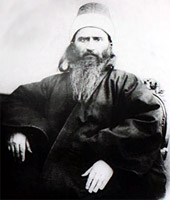 One of the Bab`s earliest disciples and strongest exponents was Mirza Hoseyn Ali Nuri, who had assumed the name of Baha` Ullah when he renounced his social standing and joined the Babis. Baha` Ullah was arrested in 1852 and jailed in Tehran, where he became aware that he was the prophet and messenger of God whose coming had been predicted by the Bab. He was released in 1853 and exiled to Baghdad, where his leadership revived the Babi community.
In 1863, shortly before being moved by the Ottoman government to Constantinople, Baha` Ullah declared to his fellow Babis that he was the messenger of God foretold by the Bab. An overwhelming majority of Babis acknowledged his claim and thenceforth became known as Baha`is.
The Baha`i (Bahai) faith underwent a rapid expansion beginning in the 1960s, and by the late 20th century it had more than 150 national spiritual assemblies (national governing bodies) and about 20,000 local spiritual assemblies. After Islamic fundamentalists came to power in Iran in 1979, the 300,000 Baha`is there were persecuted by the government.
There also exist in the Baha`i (Bahai) faith appointive institutions, such as the Hands of the Cause of God and the continental counselors. .The members of the Hands of the Cause of God were appointed by Baha`Ullah and Shoghi Effendi. The continental counselors are appointed by the Universal House of Justice. The primary functions of both groups are to propagate the Baha`i faith and protect the community.