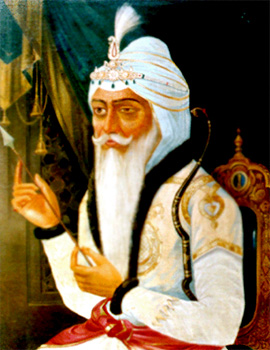
 Nirankaris, a Sikh religious sect, are the believers in the Formless One. They originated in the North West region of Punjab during the reign of Maharaja Ranjit Singh. This sect was founded by Baba Dayal Singh, whose main aim was to bring Sikhs back to the Adi Granth and namsimaran. The name `Nirankari` represents the formless quality of Akal Purakh (nirakar or nirankar) as stressed by Baba Dayal Singh. According to Dayal Das, Sikhism was decadent, filled with falsehood, superstition and error. Thus, he organized a movement and called for the return of Sikhism to its origins and emphasized the worship of God as "nirankar" (formless). The Nirankaris rejected all gods and goddesses and all types of offerings made to them. However, the movement progressed in secret until the British gained control over Punjab.
The Nirankaris focused that the proper path to reach God was through worship based on meditation rather than complex rituals. They were to worship the formless God, to obey the shabad of the guru in the Adi Granth and to clean the shoes and feet of the congregation, which is regarded as an act of humility. Other duties of the Nirankaris included serving one`s parents, to avoid bad habits and to earn one`s livelihood through work`. The Nirankaris believed that women should not be considered impure at childbirth. The Nirankaris were the sects who brought about the Anand Marriage Bill in 1908-09 to the attention of the Sikh populace. Guru Sahib Hara Singh was the fifth guru of the Nirankaris who started to reorganise the sangat.
However, there were tumultuous social changes during the reign of the British Empire and the Nirankaris were unable to keep pace with such changes. They were divided into two groups, one the original Nirankari and the other Sant Nirankaris. In 1978 the second group Sant Nirankaris was excluded by the orthodox Akal Takht for their belief in a living Guru after the Guru Granth Sahib. Gradually, more and more people got attached with the Nirankari group. After the death of Dayal Das, Darbara Singh became an energetic and persuasive leader. He was determined to cut all ties with Hinduism. In 1861, he asked permission to perform the Nirankari marriage ceremony at the Golden Temple in Amritsar. Although, the request was rejected he conducted such a service in Amritsar on 17 April, 1861. Rattan Chand succeeded Darbara Singh as the next Nirankari. He established new centers and appointed leaders for each congregation or sangat. They provided a tie between the head of the Nirankari movement and its members. After his death, his son, Baba Gurdit Singh, filled that office. Gurdit Singh headed the movement until his death on 16 April, 1947.
The Nirankaris stressed proper religious practice, issued hukamnamas to define the concepts and purpose of their movement. They built a series of worship centers staffed by their own priests. The Nirankaris thus became a permanent subsection of the Sikh religion and thus helped to clarify the lines dividing Sikhs from Hindus. Their dependence on Guru Nanak and early Sikhism for their model of `pure` religion separated them from another transitional movement, the Namdharis.