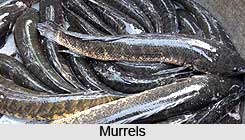
 Murrels are a group of air-breathing fishes belonging to the family Chanidae. They are also known as `snake heads` because of their depressed snake-like head and elongate body. There are six species of murrels in Indian waters; Channa marulius is the largest, growing to a length of about 1.5 metres and weighing twelve kilograms; two other smaller species are C.striata and C.punctata. Murrels are popular food fish. They live in rivers, lakes and ponds. Biologically they are interesting because of their accessory respiratory organs. On the inner upper part of the gill-chamber a small cavity is formed in which a bunch of vascular (blood-circulating) tissue is developed which helps in aerial respiration in addition to the normal respiration by gills. Because of this adaptation merrels can survive even foul waters and can migrate overland from pond to pond at night and can remain alive after capture for hours together if kept moist.
Large murrels (C.marulius) breed in the month of February and March. They build a simple nest by collecting pieces of aquatic weeds and arranging them together in a small circle. After eggs have been laid among the weeds and fertilized, the parents fan them by flapping their pectoral fins under the nest. After the eggs hatch out, the hatchlings feed for some time on the zooplankton. The parents then herd them into a close-knit group near the surface and, swimming below, they lead the young ones out to feed in richer waters. After about three months, when the young ones are about eight centimetres, the parents deliberately disperse them and if they do not disperse, the parents themselves set upon them.
A small species, C.punctatua, has been reported to breed from the month of June to October and its larvae measures 1.5 centimetres. They feed on planktonic organisms such as copepods and other minute aquatic animals. Commercially, murrels are popular and fetch high prices. They are carnivorous in habit, feeding largely on small fish and insect larvae. Due to this habit they are unwanted in piscicultural ponds but it has been found that exclusive murrel culture based on artificial feeds is practicable.