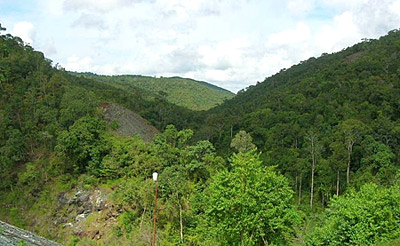
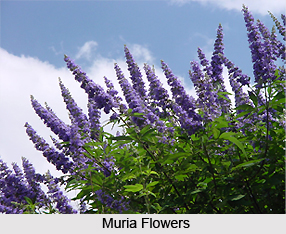
 Muria, a medicinal plant of India has various curative properties. The scientific name of Muria is Vitex altissima. This medicinal plant has got several other names as well. In Kannada language, Muria is known as Balgay, Bulgi, Myrole and Navulaadi. Moreover, in Malayalam language, this medicinal plant is called as Mayila, Mayilai, in Marathi language, it is known as Bal-Age, Banalgay. Further, in Tamil, Muria is popularly called as Maila, Mailadi, Mayilai, Myladi; and in Telugu it is called as Busi, Nemiliadaga, Nemiliadugu, Nevali Adugu, Nowli Eragu. Though most commonly found in southern India, this species of medicinal plant occurs naturally over a wide area of the Asian tropics from India, Bangladesh and Sri Lanka through Indo-China, Java and Sumatra to New Guinea. Muria is commonly found in evergreen and deciduous forests of the Western Ghats and in open dry forests elsewhere in peninsular India.
Muria is a medium sized tree usually up to 18 metres tall with somewhat drooping branches, pubescent branchlets and grey, scaly, fibrous bark. The leaves of this plant are generally of three foliate or rarely five foliate, with sessile leaflets basically lanceolate, obovate or elliptic in shape, its apex is blunt or acuminate. The largest leaflet is around 15 to 20 cm long and around 7.5 cm wide; its petioles being 5 to 10 cm long, angular or winged. Muria also bears numerous flowers of small, white tinged with blue coloured, borne in shortly paniculate or nearly sessile cymes arranged in large, lax, terminal panicles; calyx campanulate, tomentose, around 3.8 mm long; its corolla is 2-lipped, tube pubescent, with long lower lobe. The fruits of this tree are irregularly globose, 0.5 to 1.2 cm in diameter, bluish-black or purple when ripe, and are white-dotted, with a persistent, flattened calyx.
Muria is known for its various medicinal properties and uses. In Ayurvedic practice the fruits of this plant are used as a substitute for those of Piper cubeba (Piperaceae) for treating stomatitis, cardiac diseases, anorexia, blindness, leprosy, worm infestation. It is also used as a digestive and carminative. In Southeast Asia the juice of its bark is used externally to relieve rheumatic swellings and chest pains.