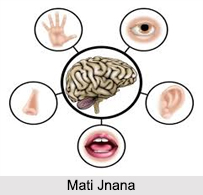
 Mati Jnana in Jainism is the knowledge of the mind, usually gained through ones senses, memory, remembrance, cognition, and deductive reasoning. It is a kind of Paroksa Jnana which includes Samvyavaharika Pratyaksa, Smriti, Samjna, Tarka and Anumana.
Classification of Mati Jnana
They are described as follows:
1) Samvyavaharika Pratyaksa: This knowledge senses the mind and is limited. It is said to be conditioned by the senses, when the senses play a major part, and the mind exerts influence in its generation; and it is said to be conditioned by the mind when it is generated by the mind alone.
2) Smriti (Memory): Memory is the cognition generated by experience. It is a cognation, which has the simulation of a memory - impression. Recollection is the cognition generated only by experience. Recollection is a type of indirect cognition. Revival of dispositions of previous knowledge is the fundamental condition of memory. It is the source of knowledge of the past.
3) Samjna (Recognition): Samjna is a synthetic cognition arising out of perception and memory. Recognition is a synthetic knowledge, which connects the present with the past. It is knowledge of the present conditioned by the past.
4) Tarka (Inductive Reasoning): Inductive Reasoning is a separate type of cognition, which serves to give knowledge of universal concomitance. The knowledge of universal concomitance is beyond the scope of perception recognition, nor is it obtained by inference.
5) Anumana (Inference): Inference is the knowledge of the probandum (Sadhya) on the strength of the probans (Sadhana). It does not mean guessing, it is true and definite knowledge based on evidence. Anumana is defining a relationship between Sadhya and through Sadhana.
Thus, what one see by eyes, hear by ears, taste by tongue as also what one remember, infer and all knowledge acquire through logic and reasoning fall within the classification of Mati Jnana.