
Marching after Proclamation of War, proclaims that the king under certain conditions shall be free to wage a war against the enemy. Chapter IV of Book VII in Arthashastra mentions that whenever the king finds that his enemy`s army has fallen into troubles, in which the troubles of his enemy can by no means be remedied, and as his enemy`s subjects are ill treated, impoverished and become effeminate and disunited among themselves, are prepared to desert their master, when his enemy`s army had fallen victim to the natural calamities or have been looted by thieves and roadside robbers which has forced them to loose their youth as well as defensive power, it shall as such allow the king to wage a war against such an enemy.
Marching after Proclamation of War further claims that a king can wage a war against his enemy if he fortunate enough to have powerful allies and powerful friends in the rear, both with brave and loyal subjects, while the reverse is the case with his enemy both in the front as well as in the rear, and when he finds his friend to hold his frontal enemy in check and his rear ally to check his rear enemy at bay he shall then confidently think of waging a war against his enemy. Thirdly, when a king finds it possible to achieve a result of victory single handed in a very short time then he may march against his frontal enemies after proclaiming war against his rear enemies, otherwise he should march after making peace. On a contrary when a king finds it difficult to confront an enemy single handed, in such condition he should make an expedition with a combination of the entire inferior, superior as well as equally power kings.
Marching after Proclamation of War as such mentions that all the wars must have a positive or negative result. A war is desirable only when the end is profitable and every king involved shall have same share of spoils which should be fixed .Arthashastra further claims that when the object aimed at is of definite nature, then the share of spoils should be fixed; but when the manifold is complex and no fixed share is possible then no such combination of friends is possible. The king may request his allies to participate or help him but that would be voluntary. Share of profit in proportion to the strength of the army is of the first kind while share equal to the effort made is the second type and share allotted in proportion to the profit earned or allotted according to the capital investment is the third type.
Thus, Marching after Proclamation of War reiterates the steps taken by the kings of Circle of States who shall decide the future of his kingdom by choosing the kind of relationship to be taken by the state. While a state can remain silent and maintain neutrality it on certain situations can settle with wars for the wellbeing of his people.
Marching after Proclamation of War
Marching after Proclamation of War had been the next step provided by Arthashastra in chapter IV of Book VII, in which it provides certain conditions for the king who can proceed and wage a war against his enemy under certain conditions.
Recently updated articles in History of India
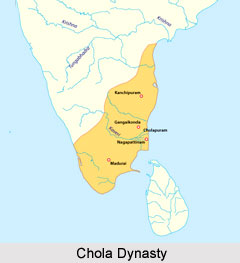
Chola Dynasty
Chola Dynasty is a Tamil dynasty and had longest duration of ruling in parts of South India. Chola dynasty had ruled South India successfully for a ex...

Suhungmung
Suhungmung was the fourteenth ruler of the Ahom dynasty who ruled from the period 1497 to 1539 AD. His reign was significant in terms of expansion of...

Princely State of Dadhalia
Princely State of Dadhalia was located in the present state of Gujarat. The state covered a total area of 28 sq miles and comprised of 15 villages. Th...

Princely State of Rupal
Princely State of Rupal was a part of the Baroda Agency, a sub division of Western India States Agency. It was under the administrative control of the...

Archaeological Sites of West Bengal
Archaeological sites of West Bengal reveal several aspects of ancient India. Excavations by the Archaeological Survey of India have furnished artefact...
Related articles in History of India

Mughal Architecture during Babur
Mughal architecture during Babur marked the foundation of a new architectural era in India, blending Timurid, Persian, and local influences. His reign...

Architecture during Sayyid and Lodi Dynasty
Architectures during the Sayyid and Lodi dynasty were mainly the tombs and monuments for the dead rulers. It were carefully designed and meticulously...

Brahmanical Sources of Ancient History
Brahmanical Sources of ancient history are contained in the Vedas and they constitute one of the most important literary sources of information about...

Coins of Chola Empire
Coins of Chola Empire were issued in gold, silver and copper and carried the Chola emblem.

Coins of Khilji Dynasty
Coins of Khilji Dynasty had an influential feature that was followed by the other dynasties.