
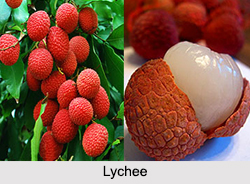
 Lychee is an Indian fruit, which is the sole member of the genus Litchi in the soapberry family known as Sapindaceae. Lychee cultivation began in the regions of China, Vietnam and Malaysia. Lychee has a history of cultivating its first seed as far back as 2000 BC, according to Chinese records. There are many stories of the fruit`s use as a delicacy in the Chinese Imperial Court. It was first described and introduced to the west in 1782. Lychee tree is a tropical tree native to China. The fruit is cultivated in countries like India (Muzaffarpur in Bihar, West Bengal, Tripura, Uttar Pradesh, Punjab and Haryana). China, Thailand and Vietnam and South-East Asia. According to folklore, a lychee tree that is not producing much fruit can be girdled, leading to increased fruit production.
Lychee
Lychee is a popular Indian fruit, which is the source of vitamin C, minerals, protein, fat, energy and carbohydrates. Lychee ranks 9th amongst fruit crops produced in India. Out of the total amount of lychee produced in India, 74 percent is contributed by Bihar.
Introduction
Lychee is an Indian fruit, which is the sole member of the genus Litchi in the soapberry family known as Sapindaceae. Lychee cultivation began in the regions of China, Vietnam and Malaysia. Lychee has a history of cultivating its first seed as far back as 2000 BC, according to Chinese records. There are many stories of the fruit`s use as a delicacy in the Chinese Imperial Court. It was first described and introduced to the west in 1782. Lychee tree is a tropical tree native to China. The fruit is cultivated in countries like India (Muzaffarpur in Bihar, West Bengal, Tripura, Uttar Pradesh, Punjab and Haryana). China, Thailand and Vietnam and South-East Asia. According to folklore, a lychee tree that is not producing much fruit can be girdled, leading to increased fruit production.Essential Conditions for the Cultivation of Lychee
 Lychee requires warm tropical to subtropical climate that is chilly, but also frost-free. The fruit can also grow when there is only very low winter frost (not below -4 degree Celsius). It requires high summer heat, rainfall and humidity. Lychee is best grown on well-drained and slightly acidic soils rich in organic matter.
Description of Lychee
Lychee tree is often less than 15 m (49 ft) tall, but sometimes it reaches a height of more than 28 m (92 ft). Its bark is grey black and the branches are brownish red. The leaves are 10 to 25 cm (3.9 to 9.8 in) in length or longer, with leaflets in 2 to 4 pairs. Lychees have foliage similar to the Lauraceae family, likely due to convergent evolution. They adapt by developing leaves that repel water. These leaves are known as laurophyll or lauroid leaves. Flowers grow on a terminal inflorescence with many panicles. These panicles grow in clusters of ten and sometimes even more. There height ranges from about 10 to 40 cm (3.9 to 16 in). They can even grow longer. They hold hundreds of small white, yellow or green flowers that are distinctively perfumed.
Lychee fruits take 80 to 112 days to ripe, depending on climate, location and cultivators. These fruits are about 5 cm long and 4 cm wide, changing in shape from round to ovoid to heart shaped. The thin and inedible skin is green when immature, ripening to red and pinkish red. It is smooth or covered with small sharp protuberances. The skin also turns brown and dry when left out after harvesting. It can easily be removed to expose the layer of sweet, translucent and white flesh. The fleshy and edible portion of the fruit is an aril, surrounding one dark brown inedible seed that is 1 to 3.3 cm (0.39 to 1.3 in) long and 0.6 to 1.2 cm (0.24 to 0.47 in) wide. Some cultivars produce a high percentage of fruits with shriveled aborted seeds known as "chicken tongues". The fruit characteristically has high price, due to more edible flesh. Lychee has a soft, delicate and whitish pulp with a fragrant flavor. As the perfumy flavor is lost in canning, the fruit is generally eaten fresh. Lychees are mainly part of various desserts.
Lychee fruits take 80 to 112 days to ripe, depending on climate, location and cultivators. These fruits are about 5 cm long and 4 cm wide, changing in shape from round to ovoid to heart shaped. The thin and inedible skin is green when immature, ripening to red and pinkish red. It is smooth or covered with small sharp protuberances. The skin also turns brown and dry when left out after harvesting. It can easily be removed to expose the layer of sweet, translucent and white flesh. The fleshy and edible portion of the fruit is an aril, surrounding one dark brown inedible seed that is 1 to 3.3 cm (0.39 to 1.3 in) long and 0.6 to 1.2 cm (0.24 to 0.47 in) wide. Some cultivars produce a high percentage of fruits with shriveled aborted seeds known as "chicken tongues". The fruit characteristically has high price, due to more edible flesh. Lychee has a soft, delicate and whitish pulp with a fragrant flavor. As the perfumy flavor is lost in canning, the fruit is generally eaten fresh. Lychees are mainly part of various desserts.
Nutritional Value of Lychee
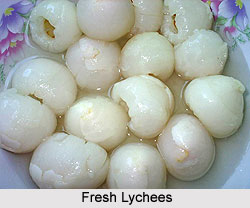 Nutritional value of lychee is huge and is one of the best fruits during the summer months. It contains on average a total of 72 mg of vitamins C per 100 grams of fruits. On average nine lychee fruits would meet a requirement of Vitamin C in an adult.
A bowl of lychee fruit, among other minerals, provide 14% Daily Value (DV) of copper, 9% DV of phosphorus, and 6% DV of potassium (for a 2000-calorie diet). Like the most plant based foods, lychees are low in saturated fat and sodium and are cholesterol free. The crop has modest quantity of polyphenols. On the phenolic composition flaven 3-ol manometers and dimmers were the major found compounds representing about 87.0% of the phenolic compounds that turn downed with browning or storage. Cyanidin-3-glucoside was a major anthocyanin and represented 91.9% of anthocyanins. Small amounts of malvidin-3-glucoside were also found.
In traditional Chinese medicine, Lychee is known for being a fruit with "hot" properties (see the six excesses for more details on the definition of heat), and excessive consumption of Lychee can, in certain extreme cases, lead to fainting spells or skin rashes.
Benefits of Lychee
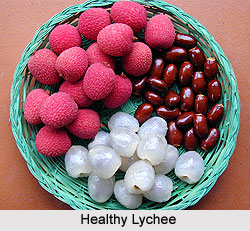 Benefits of lychee fruit are one of the main criteria for the popularity of the fruit in Indian sub-continent. This fruit has low calorie content and also does not contain any saturated fats or cholesterol. But it is rich in dietary fibre that can be very essential for individual who are also concerned about their excess body weight.
There are various research and studies that have suggested that oligonol, a low molecular weight polyphenol found abundantly in lychee fruit. Oligonol has been found to have several anti-oxidant, anti-influenza virus actions. In addition it also helps in improving the flow of blood in organs and reduces weight and protects skin from harmful UV Rays
Lychee is much like a citrus fruit and is an excellent source of vitamin C; 100 g fresh fruits provide 71.5 mg or 119% of daily-recommended value. There are studies that also suggest that consumption of fruits rich in Vitamin C also helps the body to develop resistance against infectious agents and search harmful, pro-inflammatory free radicals.
Lychee is also a very good source of B-complex vitamins like thiamin, niacin, and folates. These vitamins are also crucial for the body as they function by acting as co-factors to assist body metabolize proteins, fats and carbohydrate.
Litchi also contains a considerable amount of minerals like copper and potassium. Potassium is a central part of cell and body fluids assist run heart rate and blood pressure; thus offers fortification against caress and coronary heart diseases. Copper is necessary in the production of red blood cells.
Recently updated articles in Flora & Fauna
Indian Aloe Vera
Indian Aloe, growing to moderate heights, appears glossy, with pulpy leaves, essential in making drugs.
Amaranthus spinosus
Amaranthus spinosus is a medicinal herb found in India and is commonly known for its medicinal value.
Shilli Wildlife Sanctuary
Shilli Wildlife Sanctuary in Himachal Pradesh was established in 1963 in order to preserve the Himalayan Black Bear which is an endangered creature. D...
Flora and fauna of Karnataka
Karnataka boasts a remarkable diversity of flora and fauna, nurtured by its varied landscapes ranging from the Western Ghats to dry plains. The state’...

Vedanthangal Bird Sanctuary
Known to be the oldest water bird sanctuary in the country, Vedanthangal Bird Sanctuary is home to myriad types of migratory birds including 26 rare s...
Related articles in Flora & Fauna
Flora and Fauna of Ladakh
Flora and Fauna is typical to t he kind of mountainous terrain which dominate the entire landscape of the region. Though some varieties of fauna are t...

Flora and Fauna in Meghalaya
70 percent of Meghalaya is forested. Meghalayan forests are considered to be among the richest botanical habitats of Asia. These forests receive abund...
Flora and Fauna of Jammu & Kashmir
Jammu and Kashmir is rich in flora and fauna. Flora includes thorn bush type of the arid plain to the temperate and alpine flora of the higher altitud...
Flora and fauna in Andaman and Nicobar Islands
Economy of this region is primly based on agriculture. In Andaman island, paddy is the main food crop, while in Nicoabar island coconut and areca nut...
Flora and Fauna of Manipur
Flora and fauna of Manipur are known to be the assemblage of a huge variety including the endangered ones. The place is especially famed for orchid sp...