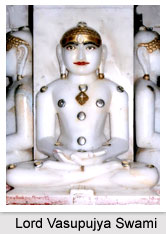
 Lord Vasupujya Swami was the twelfth Jain Tirthankara of the current age, Avasarpini. As per Jain philosophy, he became a siddha, an enlightened soul which has demolished all of its karma.
Lord Vasupujya was born to Emperor Vasupujya Raja and Queen Jaya Devi Rani at Champapuri in the Ikshvaku dynasty. He was born on the fourteenth day of the Falgun Krishna month of the Hindu calendar. Emperor Padmottar ruled over Mangalavati of Ardhapushkar Island. He was a pious man devoted to divine pursuits. In later part of his life he took Diksha from Acharya Vajranabh. He reduced his tarnish of Karma by rigorous penance and divine practices and finally earned the Tirthankar-nam-and-gotra-karma and incarnated as a God in the Pranat dimension.
Lord Vasupujya was the Emperor of Champa town in the Bharat sub-continent. His queen was Jaya Devi. Besides being a great warrior Emperor Vasupujya was a compassionate and charitable person. The queen was also generous and she inspired the Emperor in his charitable activities.
Resurrection of Lord Vasupujya Swami
The being that was Padmottar was born to Queen Jaya Devi. It is believed that when the queen was pregnant, the Emperor of Gods ascended to convey his veneration to the future Tirthankara and his mother. As Lord Indra is also known as Vasu, the new born was named Vasupujya venerated by Vasu.
As Vasupujya grew he remained completely detached and indifferent towards the materialistic wants and desires of daily life. He had no attraction for the royal splendour and grandeur of the kingdom. When he became young his parents wanted him to marry but he declined. He even informed his parents that he had no intention of ascending the throne and of ruling the kingdom. He was much convinced but in spite of all persuasions from his household members, he renounced the corporeal life. He became a Shraman on the fifteenth day of the dark half of the month of Phalgun along with six hundred other persons.
The intensity and passion of his divine practices was so profound that he became highly knowledgeable within one month. At that moment he was practicing under a Patal tree in a garden outside Champa town. He is credited with founding the four pronged religious ford. He also travelled to different places preaching people about religious matters.
The second Vasudev, Dwiprishtaha, was his devotee. He and his brother Baldev Shrivijay vanquished Prativasudev Tark and brought his oppressive rule to an end. Shrivijay later joined the ascetic order of Bhagwan Vasupujya. Lord Vasupujya got nirvana on the fourteenth day of the bright half of the month of Ashadh in Champa town.