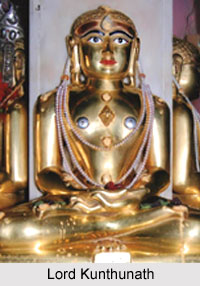
 Lord Kunthunath was the seventeenth Jain Tirthankara of the current age, Avasarpini. As per Jain philosophy, he became a siddha, an enlightened soul which has demolished all of its karma.
Lord Kunthunath was born to Emperor Shursen Raja and Queen Srirani Rani at Hastinapur in the Ikshvaku dynasty. His birth date was on the 14th day of the Vaishakh Krishna month of the Hindu calendar. The name of the powerful and famous Emperor of Khadgi town in Purva Mahavideh area was Simhavaha. He was a very devoted and religious person. When his son became young and capable he crowned his son and handed over his kingdom to him. The emperor took Diksha or vow from Samvaracharya. Due to his vigorous penance and devotion for the Arhat, he earned the Tirthankar-nam-and gotra-karma. Completing his age he reincarnated in the Sarvarthsiddha dimension of Gods.
Resurrection of Lord Kunthunath
From the dimension of Gods Lord Kunthunath descended into the womb of Queen Shri Devi, wife of Emperor Shursen of Hastinapur. When the queen was pregnant she dreamy of heap of gemstones known as Kunthu in her dreams. This inspired the Emperor to name his sons as Kunthu Kumar. The pious deeds of earlier birth resulted in unlimited power and grandeur for Kunthu Kumar. The prince with all the required pleasures of life but he remained detached from them. As he grew up Kunthu Kumar was crowned as the king and was handed over the kingdom. The emperor, Shursen became an ascetic. During the rule of Kunthu Kumar the disc weapon appeared in his armoury and he proceeded to conquer the world with his mighty army. All the kings without any confrontation accepted his sovereignty and Kunthunath became a Chakravarti. His cout remained filled with the presence of many mighty kings and princes. After a long and successful reign of twenty three thousand seven hundred and fifty years he became an ascetic along with one thousand kings. Immediately after Diksha or vow he acquired Manahparyav Gyan. He spent sixteen years as a common ascetic. He indulged in rigorous penances and other divine practices and achieved nirvana on the third day of the bright half of the month of Chaitra under a Tilak tree in Sahasramara jungle outside Hastinapur. His first discourse was on the subject of inner purity.
As a knowledgeable ascetic Kunthunath wandered to different places and preached people about true religious faith for a very long period. Before breathing his last he went to Sammetshikhar and observed a month long fasting. He had a group of devotees who deeply revered him and were devoted to him. A large crowd was present at the moment he attained nirvana. They also witnessed the cremation ceremony with heavy hearts and tear filled eyes. The mortal remains of Lord Kunthunath were later taken away by the Gods for worship.