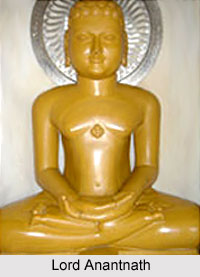
 Lord Anantnath was the fourteenth Jain Tirthankara of the current age, Avasarpini. As per Jain philosophy, he became a siddha, an enlightened soul which has demolished all of its karma.
Lord Anantnath was born to Emperor Raja Sinhsen and Queen Suyasha Rani at Ayodhya in the Ikshvaku dynasty. His birth date falls on the 13th day of the Vaishakh Krishna month of the Hindu calendar. Queen Suyasha Devi, wife of Emperor Simhasen of Ayodhya, gave birth to an illustrious son on the thirteenth day of the dark half of the month of Vaishakh. While the queen was pregnant she dreamt of very long strand of beads whose ends were not visible. During this period of time the power and the glory of the Emperor also increased manifold. It was for this reason that the child was named as Anant, meaning endless.
The prince though grew up amidst all royal pleasures; he remained detached from all materialoistic desires. When the prince matured he was crowned as the king. He proved to be a very king hearted and generous king who cared and looked after for his subjects. However, after a long and successful reign, the emperor left his kingdom and became an ascetic along with one thousand other persons. After rigorous religious practises he became very knowledgeable. He attained his nirvana on the fourteenth day of the dark half of the month of Vaishakh under an Ashoka tree. In his first discourse he elaborated the subject of the fundamentals-matter and life. He had fifty chief followers including the senior most named Yash. Purushottam Vasudev and Suprabh Baldev reigned during his period of influence. Lord Anantnath achieved nirvana at Sammetshikhar on the fifth day of the bright half of the month of Chaitra.
This article is a stub. You can enrich by adding more information to it. Send your Write Up to content@indianetzone.com