
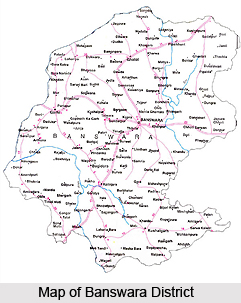
 Banswara District is situated in Rajasthan along the southern-most part of the state. It forms the eastern part of the region known as Vagad or Vagwar. History has it that the district was initially a princely state, ruled by the Maharvals. The name is said to have originated from the name of the Bhil ruler Bansia who ruled over the district. The district of Banswara has a rather rough and rugged topography with the Deccan trap on the eastern part and the Aravalli mountain ranges on the west. Tribals make up the majority of population in the district, and the main groups herein are the Bhils, Bhil Meenas, Damor, Charpotas and Ninamas among others. Banswara is an agriculture-based district with a major portion of the economy depending on the same.
Banswara District
Banswara District is located in the state of Rajasthan along the Southern part of the state. The district is primarily inhabited by tribals such as Bhils, Bhil Meenas, Damor, Charpotas, Ninamas etc.
Introduction
Banswara District is situated in Rajasthan along the southern-most part of the state. It forms the eastern part of the region known as Vagad or Vagwar. History has it that the district was initially a princely state, ruled by the Maharvals. The name is said to have originated from the name of the Bhil ruler Bansia who ruled over the district. The district of Banswara has a rather rough and rugged topography with the Deccan trap on the eastern part and the Aravalli mountain ranges on the west. Tribals make up the majority of population in the district, and the main groups herein are the Bhils, Bhil Meenas, Damor, Charpotas and Ninamas among others. Banswara is an agriculture-based district with a major portion of the economy depending on the same.Location of Banswara District
Banswara district is situated in the southern - most part of Rajasthan. It has an area of 5037 square kilometre and lies between 23.11 degrees to 23.56 degrees North latitudes and 73.58 degrees to 74.49 degrees East longitudes. It is bounded on the north by Dhariawad tehsil of Udaipur district and Pratapgarh district; on the east by Ratlam district of Madhya Pradesh; on the west by Sagwara and Aspur tehsils of Dungarpur district; and on the south by Jhabua district of Madhya Pradesh. It also touches the boundary of Panchmahal district of Gujarat on the south-west.
History of Banswara District
The Banswara district forms the eastern part of the region known as Vagad or Vagwar. The district was formerly a princely state ruled by the Maharavals. It is said that a Bhil ruler, Bansia, ruled over it and Banswara was named after his name. Bansia was defeated and killed by Jagmal Singh who became the first Maharaval of the princely state. It is also named so because of the bamboos (Bans) which were found in abundance in the forests. In 1913 some bhils revolted under the headship of a social reformer Govindgiri and Punja which was suppressed in November, 1913. Hundreds of Bhils were shot dead at the Mangarh hillock where they were holding a peaceful meeting. The event is also known as the Mini Jalianwalah Bagh massacre. The place has become sacred and is better known as the Mangarh Dham. With the merger of the princely states in the Union of India, the state of Banswara and Kushalgarh got merged in the Greater Rajasthan in 1949 and Banswara was carved out as a separate district by merging these principalities.
Geography of Banswara District
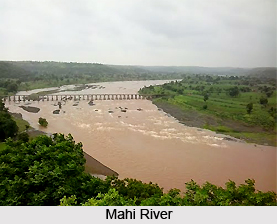 The region represents a rugged terrain undulated by short ridges west of Banswara. The eastern part of it is occupied by flat-topped hills of the Deccan trap. It has the southern end of the Aravalli mountain ranges. The drainage system belongs to the Mahi River which originates from Amjera hills near Dhar in Madhya Pradesh. Its main tributaries are Anas, Chanp, Erav, Haran and Kagdi. The Mahi Bajaj Sagar dam has been constructed on the Mahi, some 16 k.m. away from Banswara town. Right and Left Main Canals and their distributaries irrigate 60,149 hectares of land. Normal annual rainfall is about 82.59 cms. Maize, wheat, cotton, gram are the main crops grown in the district. Graphite, Soapstone, Dolomite, Rock Phosphate, Limestone and a variety of marbles are found here. Gold mineral is also found around Jagpura. Forest land consists of 20 percent of the told area but most of the forest land is devoid of trees.
Administration of Banswara District
Banswara district has three Sub Divisions, Five Tehsils, Two Sub-Tehsils and Eight Development Blocks. Tehsil Banswara and Garhi come under Banswara Sub Division, Tehsil Ghatol is under Ghatol Sub Division and Tehsil Kushalgarh and Bagidora comes under Kushalgarh Sub Division. There are a total of Eight Development Blocks in the district, namely, Anandpuri, Bagidora, Garhi, Ghatol, Kushalgarh, Choti Sarwan, Sajjangarh and Talwara. There are 1503 revenue villages, out of which 1479 are `Abad` and 24 `Gair Abad`, 307 Gram Panchayats, 215 Patwar Mandals and 28 ILR Circles in the district.
People of Banswara District
The district is predominantly inhabited by tribals mainly Bhil tribe, Bhil Meenas, Damor, Charpotas, Ninamas, etc. The district population is 14,20,601 (2001). The rural population is 13, 13,238 (2001) and the urban population is 1, 07,363 (2001). The main occupation of the people, especially of tribals, is agriculture. The tribals live in small one-room houses, known as `tapra`, which lie scattered all over the area. The other major castes are Patels, Rajputs, Brahmin, Mahajans, and Muslims. The dialect spoken in the district is Wagri, a mixture of the Gujarati language and Mewari.
Education in Banswara District
Literacy percentage is 44.63 (2001) but female literacy, though doubled as per 2001 census, is only 28.43 percent. Increase in total literacy percentage has been 18.22 because of the intensive literacy campaign in the district.
Pilgrimage Tourism in Banswara District
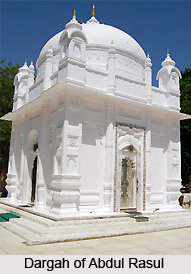
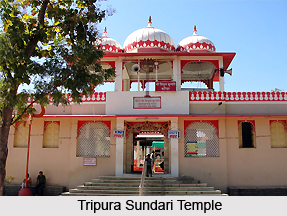 Pilgrimage tourism in Banswara District is an enriching experience as there are a number of temples located here. Most of these temples date back to ancient times. Apart from the many Hindu and Jain temples found here, there is also a place of Muslim worship, the Dargah of Abdul Rasul known as Dargah Pir, which is very popular among tourists. The various places of pilgrimage tourism in Banswara district are discussed below.
Tripura Sundari
The Tripura Sundari temple is dedicated to Goddess Tripura Sundari, commonly known as Turtia Maata. It has a beautiful idol of black stone having 18 hands, each carrying some symbol, while the Goddess is seen riding a tiger. It is believed that this temple was built before Samrat Kanishka, who used to rule here. The exact date of its construction is not yet known. It is said to be one of the `Shakti Peeths` of the Hindus having charismatic divine power.
Madareshwar
This famous temple of Lord Shiva is situated inside the natural cave of a high hill in the eastern part of the city. It presents a sensational natural view. The cave temple provides an Amarnath Yatra-like feeling to the pilgrims, due to its typical location. During Mahashivratri, rudra abhishek Pooja is carried out. Kavadi Yatra is to start from this Temple going all the way to Baneshwar Temple in order to bring the Water of Mahi River. Pooja to Lord Shiva is carried out with this water.
Andeshwar
 This is very famous Jain temple housing rare Shilalekhs of the 10th century. Such temples are also found in Talwara, Kalinjara, Bagidora, Ajna and Banswara. Most of the followers of Jainism have the culture of visiting this temple at least once in their lifetime.
Talwara
It is famous for the ancient temple of the Sun God, Lord Amaliya Ganesh, Laxmi Narayan Temple, Dwarka Dhish temple and Jain temple of Sambharnath. A number of Sompura sculpture artists can be seen carving stones on the roadside in Talwara.
Cheench
This is a famous 12th century temple of Lord Brahma. The black stone statue found here is of an average man`s height. The temple is located at a distance of 18 Kms from the district headquarters.
Ram Kund
It is a place surrounded by hills. People call it "Phati Khan" because it is a deep cave under a hill. There is a pool of very cold water which is found throughout the year. It is said that Lord Rama, during his exile, came and stayed here for some time.
Abdulla Pir
Situated in the southern part of the city is the Dargah of Abdul Rasul which is known as the "Abdulla Pir". Every year "Urs" is held at the Dargah and it is very popular with the masses. The people of the Bohara Muslim community take part in it in large numbers. The dargah is located at a distance of 3 Kms from the district headquarters.
Other well known places of pilgrimage tourism here include the Paraheada, which is a famous 12th century temple of Lord Shiva built by the Mandalik. There is also a famous Sai Baba Mandir built on top of a hill, known as the Sai Baba Mandir. These are therefore the various places of pilgrimage tourism located in the district of Banswara.
Leisure Tourism in Banswara District
 Leisure tourism in Banswara district is a truly refreshing experience. There are a number of places catering to different interests of the people, such as places of natural beauty, sites of historic worth etc. The various places of leisure tourism in Banswara district are discussed below.
Arthuna
This is a place of great archaeological importance and one of the major attractions of Banswara district. There is a complex of ancient temples here which were built in the 11th and 12th centuries. In ancient times it was the capital city of the rulers of the Paramara dynasty. Many temples have been excavated which reveal the glorious past of the district`s rich heritage. It is called the village of old and broken temples.
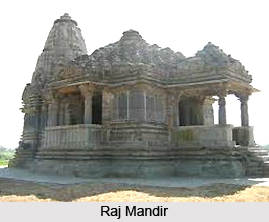
Raj Mandir (City Palace)
This 16th century palace is very attractive. Sprawling over a large area, it is a fine example of old Rajput architecture. The palace is still owned by the royal family and can be visited only on invitation.
Bhim Kund
Bhil Kund is a picturesque spot full of historical and mythological significance. It is believed that during their exile, the Pandavas of Mahabharat had stayed here. There is a tunnel here, which is believed to be going upto Ghotiya Amab, a far off place. It is said that the Pandavas used this tunnel as their passage during the rainy season.
 Anand Sagar Lake
On the eastern side of the town lies this artificial lake, said to have been constructed by Lachhi Bai of Idar - The Rani of Maharawal Jagaml. The chhatris or cenotaphs of erstwhile rulers of the state are situated close by. Also near by are the holy trees known as "Kalpa Vriksha" which are said to fulfill the desires of visitors.
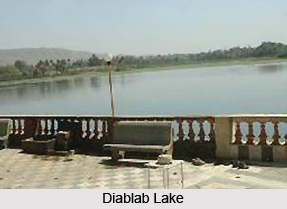
Diablab Lake
A part of this lake is covered with beautiful lotus flowers. On the banks of the lake is Badal Mahal, the summer residence of the former rulers. People used to enjoy this place in the summer by going boating.
Mahi Dam
Banswara is also well known for the Mahi Bajaj Sagar Project and for numerous dams and canals situated at beautiful sites. The Mahi River has a number of islands inside the Mahi Dam catchment area and thus Banswara is also known as the `City of Hundred Islands`.
Kagdi Pick Up Weir
This is the main tourist attraction situated on the Ratlam Road from the main city of Banswara. It`s a beautiful place, especially for its fountains, gardens and water, spread over a wide area, and a must see when on a trip to the district.
Recently updated articles in States of India
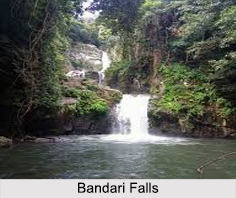
Bandare Waterfalls, Meghalaya
Bandare Waterfalls in South Garo Hills, Meghalaya, is a secluded natural attraction surrounded by dense subtropical forests and rugged mountain terrai...
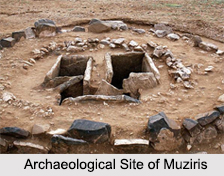
History of Thissur District
Early History of Thissur District explains flourishing of the port cities. Now these port cities are transformed into archaeological sites.
Tippi Orchid Research Centre, Arunachal Pradesh
Tippi Orchid Research Centre in Arunachal Pradesh is renowned for its rich collection of exotic and endangered orchids. Surrounded by lush rainforest...
Tourism in Nashik District
Pilgrimage tourism in Nashik district involves visiting the various places of Hindu and Jain worship located here. Some of the holiest sites for Hind...
Mangadu, Kerala
Mangadu in Kerala’s Kollam district is a significant megalithic site known for its urn burials, cist burials, menhirs, and stone circles. Excavations...
Related articles in States of India
East Indian States
East Indian States comprises of Bihar, Jharkhand, West Bengal, Odisha and also the Union Territory of Andaman and Nicobar Islands. It defines the cult...
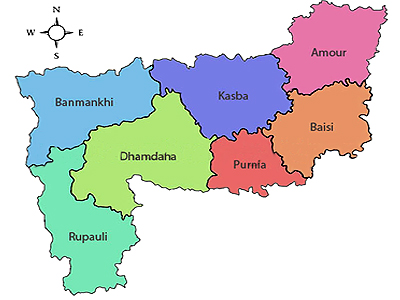
Purnia District in Bihar
Purnia District is located in Bihar and extends from River Ganga to Nepal. The district has a rich Hindu history and glorious past.
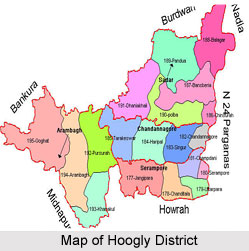
Hooghly district
Hooghly District along the bank of the river Hooghly is one of the principal trading ports of West Bengal.
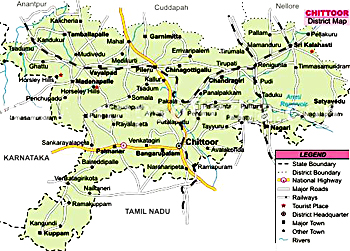
Geography Of Chittoor District
Geography of Chittoor district is spread along the topography of the land which is divided into two natural divisions; Chittoor has a dry and healthy...
Districts of West Bihar
Districts of West Bihar is comprised of medieval monuments that were built by the different governors of Mughal era.