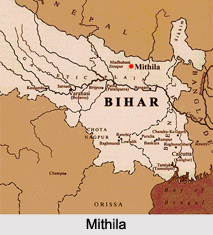
Mithila

Mithila was a renowned kingdom in ancient India and mentioned in the Puranas.

About Mithila

Mithila kingdom in ancient IndiaMithila, the modern Tirhoot was a renowned kingdom in ancient India and mentioned in the Puranas. It existed in the eastern Gangetic plains in areas which are today spread over more than half of Bihar state of India. Mithila was the capital of Videha Kingdom as per epic Ramayana. Mithila is believed to be the country of Videha and also the Kosala Kingdom. it is believed that descendants of Ikshvaku reigned Mithila for a long period.

Mithila was capital of Videha kingdom in ancient Nepal as per epic Ramayana. It is situated between foothills of Himalayas and River Ganga. The ancient region of Mithila is today split into adjacent part of 2 countries - Bihar, state of India and Nepal.

The legend of Mithila extends over many centuries. The name "Mithila" is derived after Mythical King Mithi. He was supposed to have been created from body of his father King Nimi. He established the capital of his kingdom at Mithilapuri and hence the region came to be called "Mithila". The region was originally known as Videha. Since he was born out of body of his father, he took the title "Janak". After this, the Kings of Mithila were called "Janak". This dynasty was also called "Videh Janaks". There were 57 kings in the dynasty of Videh Janak.
Mithila, Kingdom In Ancient IndiaMithila is also the name of a style of Hindu art created in the Mithila area. The most important reference to Mithila is in the Hindu epic, Ramayana where Lord Rama"s wife Sita is said to have been the princess of the land, born to King Janaka, who ruled Mithila from Janakpur.

Mithila Paintings started as a custom geometric and symbolic decoration of households done by women, mainly before a marriage the paintings. The paintings were done on the walls and floors of a house, and not known to many outside the region. After paper was brought to the area, women began to sell their artwork and expand their subjects to popular and local Hindu deities as well as to the depiction of everyday events.
History of Mithila

Mithila was the centre of earliest Brahmanical civilisation. The Videhans had their capital at Mithila. Early History of MithilaThe origins of Videha and Mithila are purely mythical. According to Vishnu Purana gives the following origin of Mithila-"Nimi, the son of Ishvaku, instituted a sacrifice and asked Vashishta to preside. Vashisha replied that he had already been engaged by Lord Indra in a sacrifice. Nimi made no answer and Vashishta thought that he had agreed and went away. Nimi employed Gautama and other rishis and started his sacrifice. Vashishta came in all haste to Nimi but finding Gautama and others employed, he cursed Nimi that he should thenceforth cease to exist in a corporal form. He cursed Vashishta in turn and both abandoned their human bodies." After Nimi`s death, the Rsis agitated his body and a boy was produced and was named Mithi (product of churning) who succeeded his father and his country came to be known as Mithila. Mithi was self-born, so his successors came to be known as Janaka, meaning, self born. According to Mithilakhand of Brihad Vishnu Purana, Videha means one whose body is gone. According to Panini, Mithila is the town where the enemies are crushed. Legends of Mithila During the time of king Janaka, Videha was at the apex of its glory. He was a contemporary of king Dasrath of Ayodhya and king Pramati of Vaishali. He concluded a matrimonial alliance with the king of Ayodhya. Janaka was the most popular king of his time. The Brahmanical system was fully stabilized in Videha. His court was thronged with Brahmanas from the Kuru-Panchal country.

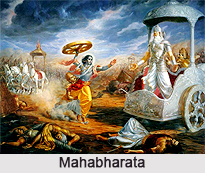
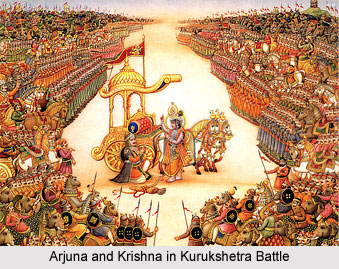
Early History of Mithila In the mantra period, Videha took a leading part in the development of Vedic culture. Mithila alo finds its mention in Mahbharata. Bhima, after the consent of Yudhisthir defeated the king of Videha in course of his Digvijaya. Kama is also said to have conquered Mithila. In the war of Mahabharata the
Maithil king Ksemdrmrti had fought from the side of Duryodhana against the Pandavas. Pandu, the father of the Pandavas, had conquered Mithila and had incurred the wrath of Maithil king. Bhima and Karna had also once attacked Mithila. All these acts of aggression had infuriated the Maithil king. Hence he took the side of the Kauravas in the Mahabharata war.

According to Mahamallaummagga Jataka, the great city of Mithila was composed in part of four suburbs extending beyond each of its four gates, and called not Gamas but Nigamas. These were named respectively east, west, south and north "market-towns". The kingdom of Videha had 10,000 villages. It was visited by merchants and during the time of Buddha, people came from Sravasti to sell their wares in Videha.

Culture of Maitha

According to Jataka the system of marriage was polygamy. The Maithil kings were men of high culture. The Videhan prince used to be educated at Taxila. Videha was famous for sword manufacture.

Kings of Mithila

The first mythical King of this region was Nimi. As per the mythological tales, Nimi died due to curse placed on him by his Guru - Sage Vashista. The name Mithila is derived after this King.

The lineage of Janaks is mentioned in "Ramayana". The list of Janaks who ruled Mithila as per Ramayana is as follows:
• Nimi
• Mithi
• Udavasu
• Nandivardhana
• Suketu
• Devavrata
• Brihadvrata
• Mahavirya : In the mythology it is stated that Mahavirya was the son of Vrihaduktha and one of the kings of Mithila. Mahavirya was also the name of a son of Bhavan-manyu, a progeny of Bharata.
• Sudhriti
• Dristaketu
• Haryasva
• Maru
• Pratibandhaka : He was the son of Maru and belonged to the family of Janaka.
• Kritaratha : He was the son of Pratipaka.
• Devamidha
• Vibhuta
•Mahidhrata
•Kirtirata
• Maharoman : Maharoman or Mahorama was the son of Kritirata.
•Hrisvaroma
• Siradhwaja : Siradhwaja is another name of Janaka, king of Mithila, celebrated as the father of Sita. Siradhwaja is remarkable for his great knowledge and good works and sanctity. Siradhwaja means `he of the plough banner`, because his daughter Sita sprang up from the furrow when he was ploughing the ground and was preparing for a sacrifice to obtain offspring. The sage Yajnawalkya was Siradhwaja`s priest and adviser. He refused to submit to the hierarchical pretensions of the Brahmans, and asserted his right of performing sacrifices without the intervention of priests. Siradhwaja succeeded in his contention, for it is said that through his pure and righteous life he became a Brahman and one of the Rajarshis. He and his priest Yajnawalkya are thought to have prepared the way for Buddha.
• Bhaanumaan / Bhanumath
• Shatadyumn / Satghumanya
• Shuchi
• Urjjavaha : He was also the son of Suchi.
• Kriti
• Anjan
• Kurujit
• Arishtnemi / Arisnami
• Shrutaayu /Srutayu
• Supaarshwa / Supasyu
• Srinjay
• Kshemaavee / Sourmani
• Anenaa
• Bhaumarath / Bhimrath
• Satyarath
• Upagu / Upangu
• Upagupt
• Swaagat
• Swaanand /Snanand
• Suvarchaa /Subrachya
• Supaarshwa /Supraswa
• Subhasa : He was the son of Sudhanwan.
Sushruta
• Jaya : Jaya is one of the kings of Mithila, the son of Gusruta
• Vijay
• Rit
• Sunay
• Veetahavya /Vith Habya
• Dhriti / Dwati
• Bahulaswa : He was the last king of Mithila. Kriti, with whom terminated the family of Janaka was the son of Bahula.
Kriti
• Sudhanwan : Sudhanwan is the son of Saswata

Mithila after Janaks : It is said that the last King of Janak Dynasty - Kirti Janak was an atrocious ruler who lost control over his subjects. He was dethroned by public under leadership of Acharyas. Thereafter, Mithila remained without King for hundreds of years. Instead of King, a democratic system was followed where the ruler was elected by the people and the decisions were taken in a collective manner.

Coins of Mithila

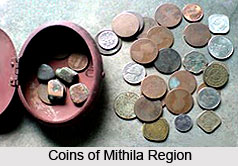
Coins of Mithila, Coins of Independent KingdomOinvara dynasty had established its kingdom in Mithila during the time of the Tughlaqs. The rulers of this dynasty had issued coins in gold and silver. The coins bore legend and sometimes the names of the kings with the era.
Siva Singh the seventh member of this dynasty had issued some tiny gold coins. The coin bore the `Sri` on the obverse and `Sivasya` on the reverse side of the coin. Apart from the gold coins, silver coins were issued during the time of Bhairava Simha of this dynasty. These coins followed the weight standard of 162 grains and they bore a long legend divided into two parts. This was placed in a square area. The legend contained `Maharaja Sri Darpanarayan-atmaja Tribhuktiraja Sri Bhairavasimhasya`. The regnal year was placed on one side in the four corners and the Saka era in a similar way on the other.

At the same time, another family ruled in the territory south of Nepal on both sides of the river Gandak. One of the rulers of this dynasty, Madansimhadeva, ha also issued coins which bore the Nagari legend `Govinda-charana-pranava-Madana` on the obverse and `Champakaranyasya` on the reverse side of the coin.

Janakpur - City in Mithila District

Janakpur is a ruined city. Janakpur is situated in the northern skirts of the Mithila district. Janakpur is supposed to indicate the site of a city founded by one of the princes of that name.

Janakpur is the birthplace of Sita, daughter of King Janaka and wife of Lord Rama. It is also said to be the site of Lord Rama and Sita`s wedding. Lord Rama won Sita by picking up Lord Shiva`s bow and breaking it in Janakpur. The city is charged with a devotional mood and is an interesting holy city to visit. Janakpur is a web of mostly narrow streets, so it is difficult to know what direction one is going in.

Recently updated articles in Indian Puranas

Kausika, Son of Vasudeva
Kausika, Son of Vasudeva Thumbnail

Kausika, Son of Vasudeva

Kausika is a minor figure in Hindu mythology and is identified in the Vishnu Purana as the only son of Vasudeva and his wife Vaishali. He is recognize...

Tandu, Attendant of Lord Shiva
Tandu, Attendant of Lord Shiva Thumbnail

Tandu, Attendant of Lord Shiva

Tandu is revered as the divine attendant of Lord Shiva and the foremost exponent of the Tandava dance. According to the Natya Shastra, he instructed S...

Niramitra, Mahabharata
Niramitra, Mahabharata Thumbnail

Niramitra, Mahabharata

Niramitra was a son of Nakula and Kareṇumati in the Mahabharata. A descendant of the Pandavas and the Kuru dynasty, he fought on the Pandava side duri...

Mahodara, Ramayana
Mahodara, Ramayana Thumbnail

Mahodara, Ramayana

Mahodara was a prominent Rakshasa warrior, minister, and army chief who served under Rāvaṇa during the Battle of Lanka in the Ramayana. Celebrated for...

Lalabaksha, Hell in Purana
Lalabaksha, Hell in Purana Thumbnail

Lalabaksha, Hell in Purana

Lalabaksha is one of the hells described in Hindu Puranic literature, particularly in the Bhagavata Purana and the Devi Bhagavata Purana. It is a real...