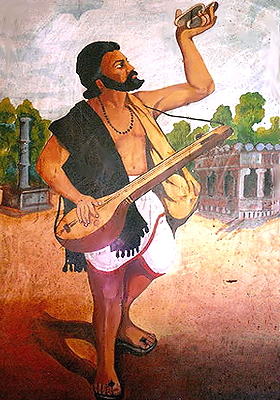
 Kanaka Dasa (1509-1609) was a singer saint from the state of Karnataka. He is recognized for his Kirtans and Ugabhoga compositions in Kannada for Carnatic music.
His original name was Thimmappa Nayaka and he belonged to chieftain family of Kaginele in Haveri district. As he belonged to the warrior community his defeat in the field of battle led him to devotional path. Later on he came to be known as Kanaka Nayaka as he found a treasure trove of gold. He was able to analyze the society microscopically. He had a neutral opinion about all faiths.
Kanaka Dasa (1509-1609) was a singer saint from the state of Karnataka. He is recognized for his Kirtans and Ugabhoga compositions in Kannada for Carnatic music.
His original name was Thimmappa Nayaka and he belonged to chieftain family of Kaginele in Haveri district. As he belonged to the warrior community his defeat in the field of battle led him to devotional path. Later on he came to be known as Kanaka Nayaka as he found a treasure trove of gold. He was able to analyze the society microscopically. He had a neutral opinion about all faiths.
He also joined the Haridasa movement and became a follower of Vyasaraja who gave him the name. His poems deal with many aspects of life as well as depict the ineffectuality of external rituals. He addressed social issues as well as included devotional aspects. He was aggressive and straight forward by nature thereby criticized evils of society. His poem "Kula Kula Kula vendu hodedhada dhiri" is one such poem. He worshipped Adhikeshava of Kaginele. All his Carnatic Music compositions end with mudra Kaginele Adhikeshava. He was also a social reformer. He tried to reform the backward communities by convincing them to give-up their obsolete social practices and adapt to the changing world. He also used music in order to convey his philosophy.
He authored poetries like Narasimha stotra, Ramadhyana Mantra, and Mohanatarangini at a young age. There was an innovation in his writings. His major works are: Nalacharitre (Story of Nala), Haribhaktisara (crux of Lord Krishna devotion), Nrisimhastava (compositions in praise of Lord Narasimha), Ramadhanyacharitre (story of ragi millet) and Mohanatarangini (Krishna-river). He composed around two hundred forty Karnataka Music compositions. In Ramadhanyacharitre there is an allegory on the conflict between the socially strong and weak castes. This has been presented as an argument between two food grains, rice and ragi. He rationalized bhakti by giving worldly similes. His compositions possessed an intimate touch that helps the reader to identify himself with the poet.
It excels in depicting contemporary life. The description of Shri Krishna`s Dwaravati (Dwaraka) is very similar to that of Vijayanagara, under Krishnadeva Raya as noticed by foreign travellers. The market place with colourful stalls with various commodities, well demarcated lanes brimming with craftsmen, clients and merchants, royal garden parties and glory of the palace find their place in Mohanatarangini. It echoes the contemporary Portuguese travellers` accounts. A drinking bout of men and women of working class is very picturesque. The reader feels as if Kanakadasa is providing a commentary of a live event. It is for such unconventional and down-to-earth descriptions as also for social awareness that the great poet-saint has become immortal.
Kanakadasa was the follower of Sri Vyasaraja Swamiji. On his advice he had come to Udupi. He was lost in prayers standing outside the matha. It is believed that he had darshan of the lord through a small window. It is a memorable to Kanakadasa. The idol of Lord Krishna is worshipped even today through the window and the latter is known as Kanakana kindi.