 Jiva in Jainism is pure and devoid of bondage at all times. The pure nature of the soul is obscured due to Karma but can be secured by spiritual Sadhana comprising of Right Faith, Right Knowledge and Right Conduct. The self is capable of being known by a process of self-realization. Jiva has the potentiality to attain supreme happiness – Moksha.
Nature of Jiva in Jainism
According to Jainism, there are infinite Jivas or souls. Every soul possesses the rapacity to know. In other words they are conscious by their very nature. Of the infinite souls, some infinite are liberated while other infinite are in a state of bondage or transmigratory existence in four Gatis. Jivas also have the tendency of going in the upward direction. Hence, in the liberated state when there are no binding factors, the pure soul rests in peace on top of the universe (Siddha Kshetra). Though the Jiva resides in the body in the state of transmigration, it is different from the body and all the adjuncts that accrue to it are on account of its association with the body. The true nature of Jiva is Pure Consciousness and Bliss.
A soul in a bound state develops a perceptible gross body and in its liberated state possesses an imperceptible subtle body. In both cases a soul has substance or matter and both are modifications of the same entity. In the bound state it has limited knowledge, acquired indirectly through the agency of the mind and its faculties, whereas in the liberated state it has direct and instant knowledge of everything through its own omniscience.
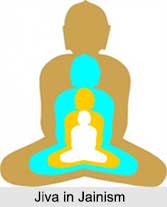
According to Jainism, a soul has also dimensions, and is subject to expansion and contraction depending upon the body it occupies. Since the soul is always larger than the body and envelops it, as the body grows and changes its size and shape with age and other conditions, the soul in it also grows and changes accordingly in proportion.
Goal of Jiva in Jainism
When a being dies, its soul contracts into a seed form and leave the body. A soul is either free or bound. In its bound state it is subject to Karma and rebirth. On earth, depending upon its Karma, a soul may be born in a mobile or immobile body. Some bound Souls are capable of achieving liberation through self-effort, but some due to the lack of it remain forever bound to the cycle of births and deaths.