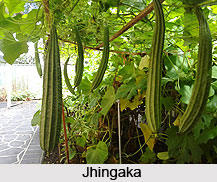
 Jhingaka, an Indian Medicinal Plant, is a large annual climber. The scientific name of Jhingaka is Luffa acutangula. Jhingaka is commonly cultivated throughout India in gardens for its fruits as these are edible. This Indian medicinal plant is considered to be indigenous to the subcontinent and is found wildly in northwest India, Bihar, West Bengal, Sikkim and Assam, and in Tamil Nadu.
Naming of Jhingaka
The Indian medicinal plant, Jhingaka, is known by several names in various parts of India. In Bengali it is known as Jhinga and Sataputi; in English as ridged or Ribbed Gourd; in Gujarati as Ghisoda; in Hindi as Jhimani, Jhinga Tori and Kali Tori; in Kannada as Heere Balli and Kirekayi; in Konkani as Gonsali, Sir-Gonsolim and Sirgousali; in Malayalam as Djinji, Piccinna, Pichenga and Puichenggah; in Marathi as Dodali,
 Sataputi and Shirola; in Oriya as Janhi; in Tamil as Pekankai, Pikunkai and Pirkankai; in Telugu as Birakaya and Burkai and in Urdu as Torai.
Characteristic Features of Jhingaka
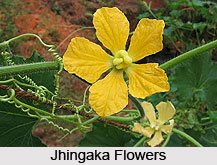
Jhingaka is a large, annual climber with slender, shortly pubescent, 5-angled stems; tendrils usually 3-branched. Leaves are alternating with orbicular in outline. The petioles of this Indian medicinal plant are angular. The male flowers of Jhingaka are yellow in colour with 3 stamens, borne in 10 to 20-flowered racemes that are 10 to15 cm long. The female flowers of Jhingaka are yellow, solitary grown in same axils as males. The fruit of this Indian medicinal plant are cylindrical or club-shaped, tapering towards the base. The fruits are usually 15 to 30 cm in length with 10 prominent, narrowly angled, longitudinal ridges. The seeds of Jhingaka plant are compressed, 0.9 to1.4 cm long and 0.5 to 0.8 cm wide, slightly corrugated on edges, not winged, black or white when ripe.
Medicinal Uses of Jhingaka
The flowering of Jhingaka occurs mainly in July and August and fruits mature in September and October. The slender 5-angled stems vegetable, Jhingaka is endowed with multiple medicinal properties and uses. In Ayurveda, the fruit and leaves of this Indian medicinal plant are considered stomachic, antibilious and antipyretic. Jhingaka are both used to treat bronchitis, and the leaves are used to treat asthma. The pounded leaves are used as a poultice to treat hemorrhoids, leprosy and splenetic. The juice of the fresh leaves of Jhingaka is useful for treating granular conjunctivitis in children. In some rural parts of southern Bihar, the fine paste of the tendrils of the vegetable is used externally and internally to treat snake bite. The ripe seeds are bitter in taste and posses emetic and purgative properties. Even though the seed oil of Jhingaka is toxic, it is used as a local application to treat skin infections among the inhabitants of Bhadrak District in northeastern Odisha.