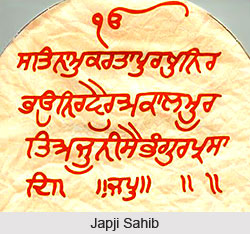
 Japji Sahib contains the main hymn which is followed by more thirty eight songs. This appears at the very beginning of the Guru Granth Sahib. It is regarded as very important set of verses by the Sikhs.
Guru Nanak`s basic concern in life was the human need which was expressed at the beginning of Japuji Sahib in the form of a question:
"Kiva saciara hoia Kirva kurai tutai pali".
In Japji Sahib Guru Nanak Devji also rejected the existing spiritualities. Guru Nanak formulated five stages of spiritual development which has been stated in Japuji Sahib. They are: Dharam Khand or the realm of duty, Gyan Khand or the realm of knowledge, Saram Khand or the realm of the bliss, Karam Khand (the realm of grace) and Sachi Khand or the realm of truth.
* Dharam Khand is the first stage where all human beings are equally placed on earth to do their job. Moral duties are given more importance as based on their performance they move on to the second stage.
* Gyan Khand is the second stage in which human beings try to gain knowledge of the supreme and the Universe. A person is supposed to know about his/her restrictions as this helps one`s ego get dissolved. This helps the person to enter into the third stage of spiritual journey.
* Saram Khand is the third stage, in which the human being experiences the development of inner self. This helps one to develop a healthy mind as well as refines the physical sense. They experience a Divine presence which helps the person to enter into the fourth stage of life journey.
* Karam Khand is the fourth stage, in which the human being receives God`s grace that assures the human being, the fulfilment of his/her search of journey as well as gives strength to enter into the final stage of spiritual journey.
* Sack Khand is the final stage and it is in this realm, where the eternal Being lives. The human being comes in complete unity with the Formless and begins to meet face to face infinity and transcendental aspects of the Ultimate Reality.