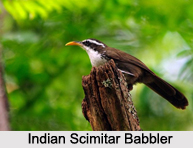
 Indian Scimitar Babbler is an Indian Bird that bears a scientific name "Pomatorhinus horsfieldii" usually has the habitat in dense jungles of Himalayan Mountain Range and Southern part of India.
Category of Indian Scimitar Babbler
Indian Scimitar Babbler is an Old World Babbler.
Habitat of Indian Scimitar Babbler
Indian Scimitar Babbler is found in peninsular India in a range of forest habitats. Indian Scimitar Babblers are most often detected by their distinctive call which is an antiphonal duet produced by pairs within small groups.
Forage of Indian Scimitar Babbler
Indian Scimitar Babblers are often hard to see as they forage through dense vegetation.
Structure of Indian Scimitar Babbler
The long curve yellow, Scimitar-Shaped Bills give them their name. It has been treated in the past as subspecies of the White-Browed Scimitar Babbler which is found along the Himalayas but now separated into two species, the peninsular Indian species and the Sri Lanka Scimitar Babbler (Pomatorhinus melanurus).
Size of Indian Scimitar Babbler
The most distinctive feature of this 22 cm long bird is the long down-curved yellow bill which is blackish at the base of the upper mandible. It has a striking head pattern, with a long white supercilum above a broad black band through the eye. The white throat and breast contrast with the dark greyish brown on the upper side and dark grey to black on most of the underside. The tail is broad, long and graduated. They have short, round wings and being weak fliers are rarely seen flying in the open.
Bills of Indian Scimitar Babbler
Indian Scimitar-Babblers have long down-curved yellow bills, used to work through the leaf litter in search of their food which is mainly insects and berries. Indian Scimitar babblers can be difficult to observe in the dense vegetation they prefer, but like many other babblers, these are noisy birds, and the characteristic bubbling calls are often the best indication that these birds are present.
Call of Indian Scimitar Babbler
The call of Indian Scimitar Babbler itself consists of a loud fluty oop-pu-pu-pu followed immediately by a krukru. The second note is produced by the female and the duet is accurately synchronized. Leucistic plumages have been recorded.
Distribution of Indian Scimitar Babbler
Indian Scimitar Babbler is the only scimitar babbler in Peninsular India. This species is found south of line between Rajasthan and Odisha.
Breeding of Indian Scimitar Babbler
Indian Scimitar Babblers breed from December to May.
Nests of Indian Scimitar Babbler
The nests of Indian Scimitar Babbler are large and loose globular mass of foliage concealed in a bush on the ground or low down.
Eggs of Indian Scimitar Babbler
Indian Scimitar Babbler usually lay three eggs (but varies from two to four) which are pure white in colour.