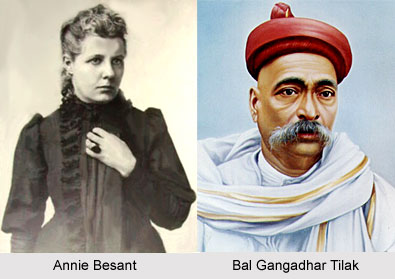
 The home rule movement in India was initiated by many nationalist leaders in the year 1916, led by Annie Besant. She was influenced by the Irish Home Rule League, and thus formed the All India Home Rule League, a political association with the objective of attaining self-government and to achieve a position of dominion in India, against the British rule. The objective of the league was to educate the people and provide the congress demand for self-government with the support and strength of a nation united in knowledge of itself and its single aim.
Origin of the Home Rule Movement in India
During the years 1916-18, Bal Gangadhar Tilak and Annie Besant, who led the Theosophical Society, organised a nationwide alliance of leagues throughout India, along with renowned Indians like Sir S. Subramania Iyer, G. S. Khaparde, Mohammad Ali Jinnah, with the aim to demand and implement the home rule movement in India. The objective was to establish self-government inside the British rule. Bal Gangadhar Tilak started the initial league in Pune, whereas S. Subramania Iyer and Annie Besant headed the league in Madras and Jinnah lead the Bombay division. Most activities were undertaken in the cities of Calcutta, Bombay, Madras and the head was situated in Delhi. The movement made significant upheaval and made the Indian National Congress take notice of the situation. It also attracted the attention of All India Muslim League. Tilak promoted the idea of `Swaraj` and also demanded that separate linguistic states be formed and education should be provided in local vernacular languages. The league, represented by eminent leaders submitted petitions to the British administration demanding self-government status. Due to the efforts of Annie Besant, Indian National Congress and the Indian Muslim League got united for the cause. The movement spread further inland and into the rural areas after the arrest of Annie Besant. Thus the reach of the league extended up to Gujarat, Odisha, Bihar, Punjab, Madras as well as Sindh as all supported the national political movement. The home rule movement failed to influence the common mass of people although it generated adequate response from educated Indians from the cities.
Influence of Gandhi on Home Rule Movement in India
During this period, Mahatma Gandhi gained significant response from the people with his non-violent forms of protests and movements, particularly with Satyagraha and the civil disobedience movement. Gandhi`s approach was well received by the common people and his admiration for Indian culture made him well renowned all over the nation. This decreased the growth and pace of the Home Rule Movement and thus delayed its activities.
Decline of Home Rule Movement in India
Mahatma Gandhi"s protests for improvement of the farmers of Bihar, Kheda, Gujarat and Champaran, gained him much recognition and propelled him to the position of a national hero. Gandhi`s focus was on the numerous rural people who were suffering more than the educated urban people. Most of the national leaders, like Bal Gangadhar Tilak, Annie Besant, Lala Lajpat Rai, Bipin Chandra Pal, and Mohammad Ali Jinnah, conflicted with Gandhi`s vision, as they preferred discussions and negotiations with the British administration.
After the Montagu Declaration the league agreed to suspend its expansion of the movement. Then all the candidates gave up their membership of the league. The league believed that the British government will gradually reform the administration and local representative system by allowing the participations from local Indians.
Eventually, Gandhi single-handedly transformed India`s political scenario along with the alteration of views and activities of the Indian National Congress. In 1920, Mahatma Gandhi was elected as the president of the All India Home Rule League and within the next year it combined with the Indian National Congress to form a unified national political body.