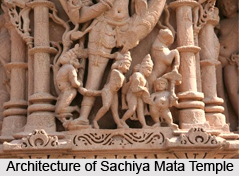
 History of Sachiya Mata Temple is quite interesting, as it combines mythological tales which belong to two religions, Hinduism and Jainism. This temple had been erected by King Upendra, a Parmar ruler, for his `Kuldevi` in the period between 9th to 10th century C.E. Sachiya Mata Temple, situated at Osian in Jodhpur, Rajasthan is dedicated to Goddess Sachiya, who is the wife of Lord Indra. There are two mythological legends which describe elaborately the history behind the naming of this temple.
Hindu Mythological History of Sachiya Mata Temple
The Asura king Pauloma was the father of Goddess Sachi and he reigned over a vast empire. He was renowned for his generosity and several Brahmins were patronized by him. The great Indian saint Shukracharya, who was engaged in a research on the subject `immortality` was one of his patrons. Vrut or Vritra, was the chief of the royal army of Pauloma, and he desired to marry Sachi. However, Sachi was against this marriage since she did not consider Vrut worthy of her, as he served her father. When he became aware of Sachi`s feelings, he resigned from the royal service and prayed to Lord Shiva, thereby attaining his blessings as well as a boon. According to the boon, Vrut became invincible as no weapons would be capable of inflicting harm to him. Empowered with his new strength, Vrut created a large army, with an aim to conquer the Aryan lands. His intention was to build a kingdom which would be greater in size as compared to that of King Pauloma.
The King of Gods, namely Lord Indra intervened at this point, since he had been entrusted the responsibility of protecting the kingdom from Vrut. Lord Indra knew that Vrut was indestructible with regular weapons, so he beseeched sage Dadhichi to lend his bones to him, as Dadhichi`s bones were reputed for being much tougher than any ordinary weapon. With help of a self-sacrifice, Dadhichi lent his bones to Lord Indra, who created a war weapon called `Vajra` form them. The armies of Indra and Vrut met on the battlegrounds, where the former said that the combat would take place on a one-to-one basis since he was refused to spill the blood of several people. The agreement was that the winner of the battle would capture the other`s army and also marry Sachi. Lord Indra emerged victorious in this war and thus married Sachi.
Jain Mythological History of Sachiya Mata Temple
As per the records of a stone inscription, there exists a different legendary account which describes the naming as Sachiya Mata. Acharya Shrimad Vijay Ratnaprabhasuriji Maharaj Sahib, a Jain monk had travelled to Osian for the purpose of performing `Anjan Salakha` a ceremony at the premises of the temple dedicated to Lord Mahavira which was constructed around 43 C.E. This temple is said to have been created by Uhad, a minister of the then ruler, King Upaldeo. During that time, Osian was referred to as `Upkeshpur`. There was a temple whose presiding deity was Goddess Chamunda, or `Jagat Bhavani` at Upkeshpur town. Devotees used to offer sacrifices of male buffaloes at this temple, to appease the Chamunda Mata, particularly during Navaratri.
The Jain monk was pained when he heard about the sacrifice and felt compassion for the animals that were sacrificed. He, therefore, persuaded the king and his minister to immediately ban the animal sacrifice at the temple. However, Goddess Bhavani was extremely annoyed by his actions and tortured the monk. Acharya Shrimad Vijay Ratnaprabhasuriji Maharaj Sahib bore the assaults boldly and this finally brought about an alteration in the heart of Chamunda Mata. She was convinced about the evil nature of this sacrifice and Herself came to the conclusion that from then onwards her devotees must not offer Her anything which symbolised blood, including red flowers. Pleased with the Jain monk, the Goddess blessed him as well as the followers of Jainism. Thereafter, the Jain monk gave Goddess Chamunda a new name, called `Sachi Mata`, or the `Real Mother`.