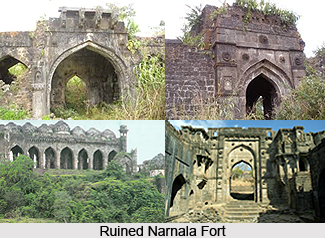
 History of Narnala Fort encompasses the detailed explanation of the political scenario during the time when the Narnala Fort had been built in Akola District near Berar in the Indian state of Maharashtra. This fort is also known as `Shanur Fort` and is a hillside fortress which was named after Narnal Singh, a Rajput king. It is said that Gond rulers had constructed this fort during 10th century AD. Sultan Mahmoud Gazhnavi had created the Narnala Fort and he was Bagh-sawar wali Hazrat Burhanuddin`s follower. After Narnala Fort was established Berar was conquered by the Mughal emperor Akbar. Then the Narnala Fort was reconstructed, following the style of Mughal architecture, and a mosque was built inside this fort.
This fort was remodified by Ahmad Shah Bahamani in 1425 when he had created Gavilgad for the purpose of preventing the invaders who belonged to the northern frontiers on his kingdom. Fatehulla Imad-ul-mulk became the new owner of this fort during 1490 after he was made the independent king of this region. Prior to this, he served as the Subhedar of Berar under the reign of Bahamanis. In this fort, Burhan Imad Shah had been confined in imprisonment by Tufalkhan who had declared himself the emperor. In the war between Murtaza Nizam Shah and Tufalkhan during 1572, Tufalkhan lost and retreated to a man named Muhammad Shah of Khandesh. However, Murtaza Nizam Shah threatened Muhammad Shah of fatal outcomes if he provided shelter to Tufalkhan which prompted him to immediately refuse asylum to Tufalkhan. So Tufalkhan was compelled to return to Narnala Fort and reside there.
The army of Murtaza occupied the Narnala Fort and the fort was surrendered after which Burhan Imad Shah and Tufalkhan were captured as prisoners, along with 40 others. These prisoners were kept in Lohagad Fort and here they perished. Certain historians are of the view that Murtaza Nizam Shah had all of them poisoned. On 26th January, 1597, a fierce battle was fought between Akbar and the troops of Ahmadnagar kingdom. The emperor Adil Shah and his ally Kutub Shah, ruler of Golconda emerged victorious in this battle. A motorable road is utilized to approach this fort.