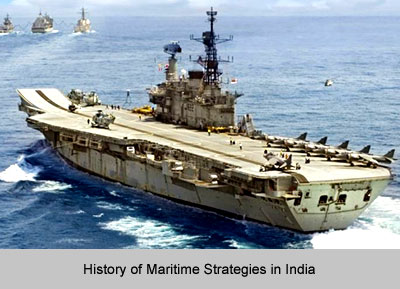
 India has always been a country conquered and defeated by umpteen empires, invading either by land or sea. Setting aside the land subjugations, oceanic invaders had occupied substantial importance in Indian maritime history. The fact remains that Indian emperors had been competent and clever enough to resist such oceanic attacks, very much highlighting the shrewd maritime strategies in erstwhile India. As a maritime nation, one of India`s national interests is free and open use of the seas for communication and trade. As defence technology and weapon platforms have developed over the years, the security of sea lines of communication need to consider threats from sub-surface, air and space dimensions. The continuing development of offshore oil extraction and the living and non-living resources in the seas around India affect the manner in which India must look at the sea for economic well-being. Accordingly, the application of any creditable maritime strategy must comprehend and exercise the judicious use of the seas for legitimate commercial, scientific, economic and security interests. This is not only in terms of the sustainment of India`s economic growth and development, but also for the country`s overall national defence.
The internal factors of maritime strategy are well controlled by India through a broad approach of maintaining an appropriate level of naval forces and Coast Guard vessels, merchant marine, ports and commercial shipping and commercial fishing vessels. India`s maritime strategy should correlate the free use of the seas in order to pursue her national interests while allowing for and the use of the seas by other countries for their own interests. India`s prevailing position in the middle of the Indian Ocean, the country`s vast coastline and island territories bestow upon her the status of a maritime nation. India`s maritime strategies date back to the ancient times, enriched in historical accounts. Trade across the seas, flourished even during the Indus Valley Civilization. An overwhelming majority of India`s foreign trade was and is still sea-borne. The country`s geographic location in the centre of the Indian Ocean Region (IOR) puts India right in the middle of the international trade routes. Furthermore, India has plethoric manpower, a skilled work force and a resurgent economy, which has made gigantic strides in the past decade. Post independence, India had the opportunity to assume Britain`s role as the stabilising influence in the region.
History of maritime strategies in India date back to long centuries, precisely to the Vedic Period. The importance of the seas to the well-being of India was well understood as early as the third century B.C. Ancient India`s interest in the oceans is evident from the fact, that the Rig Veda, written around 2000 B.C., delineates hundred oared naval ships undertaking expeditions to conquer other kingdoms. The discovery of a tidal dock at Lothal, presumably constructed around 2300 B.C. lends further weight to the theory. Evidence also indicates that Indian rulers had established extensive trade ties with Rome, Greece, Arabian peninsula, Persia and East Africa on the West and South East Asian Islands and the far away China, on the East.
However, after prolonged sovereign rules of both Hindu and Muslim kings, history of maritime strategies in India altered vastly with the advent of European powers. The actual decline of Indian maritime power commenced in the thirteenth century. Though the Mughals held sway in the Indian subcontinent, they lacked maritime vision and thus made no solemn attempt to use the sea to propagate their influence. Had the Mughals comprehended the value of sea power, they would perhaps have established a fleet. This would have successfully enabled them to defend their empire from the European powers. Indian maritime strategy was almost non-existent during the time the Portuguese arrived in India in the fifteenth century. Though the Zamorins and the Marathas challenged the advent of the European naval forces momentarily, the years of negligence took their toll. Subsequent to which, the European navies ruled the Indian Ocean for the next four hundred years.