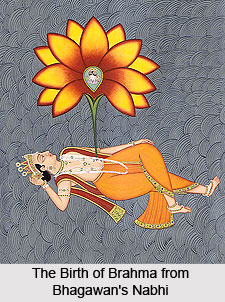
 According to Hindu religion Hiranyagarbha means the golden womb which is the source of the creation of the universe It is the origin and creation of both the cosmos and the universe according to the Vedic scriptures .It is said in hymns that Hiranyagarbha floated around in water in the emptiness and the darkness of the non-existence for about a year, and then broke into two halves which formed the Swarga and the Prithvi.Brahma is believed to have born from the Hiranyagarbha. In the Rig veda , `hiranya` or gold is the `Prana`, the life and `garbha` the `Bhuta`, the matter. The Rigveda observes that it was the single egg but split into two- the `Prana`(the life) and `Bhuta`(the body). The Rigveda does not elaborate the point any further but its symbolism moves into two apparent directions. Egg contains both, the life and the matter. When it splits, the life and the matter both fall apart.. The Rigveda calls them as `aprana` and `saprana`. The matter has life but is just the single Egg, the inherent aspect of the female, as by itself it is unable to further the creative process and it is thus only the inactive `Bhuta`. It is only after the male energy fertilizes it that it becomes the Golden Egg- the life-bearing one, the Hiranyagarbha of the Rigveda. And, now the Hiranyagarbha- the `Bhuta` combined with `Prana`, the matter energized by spirit, takes to its own form and defines creator.
In the Rig Veda Hiranyagarbha is celebrated with all the attributes of supremacy. In the 121st hymn of the tenth book this god is said to have arisen in the beginning. Mentioned as the one lord of all beings, who upholds heaven and earth, who gives life and breath, whose command even the gods obey, who is the god over all Gods, and the one animating principle of their being.
This article is a stub. You can enrich by adding more information to it. Send your Write Up to content@indianetzone.com