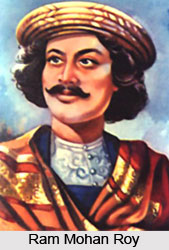
 Raja Ram Mohan Roy founded the Hindu Dharma Sabha in 1830. Hindu Dharma Sabha with its distinct aura further reshaped the contour of Indian renaissance to a great extent. This was not an organization of strictly orthodox pundits; rather most of those involved in the Sabha were closely connected with the English government. In order to achieve their goal of restricting western influence on the society, they borrowed the organizational techniques of the West as well as the new technology of printing. Each and every programme of the Dharma Sabha aimed at limiting the infringement of English culture. For them, Ram Mohan Roy appeared as going too far with his efforts to change Hinduism and confirmed too great an acceptance of Christian ideas.
Ram Mohan Roy first attempted to establish an organizational base for his ideas when in 1815 he established the Atmiya Sabha (Friendly Association). That was just the beginning of Indian renaissance. The Atmiya Sabha was a private society that held weekly meetings at Ram Mohan Roy`s residence. The members recited Hindu scriptures, sang hymns, and conducted discussions on religions and social issues. The society however stopped meeting sometime in 1819. Nine years later Roy organized the Brahmo Sabha that executed its first meeting on 20 August 1828. The Sabha gathered every Saturday evening from seven to nine. The service of this Samaj comprised of selections from the Upanishads first chanted in Sanskrit and then translated into Bengali, a discussion in Bengali and the singing of theistic hymns. Anyone who wished could attend the meetings, but those who did were almost all Bengali Brahmans. At this time there was no discrimination of membership, no creed, and no formal organization.
On 23 January 1830, the Hindu Dharma Sabha began its actual tenure in a new building constructed by Ram Mohan Roy and his supporters. A Trust Deed filed by Ram Mohan Roy provided an imprecise statement of ethics for the Sabha. It included a reaffir-mation of egalitarianism that was Roy`s concept of the deity, `the Eternal Unsearchable and Immutable Being who is the Author and Preserver of the Universe, an embargo of all kinds of idolatry and sacrifice. The ethics also empowered a ban on criticism of other spiritual beliefs and practices. Ram Mohan Roy did not elaborate on these principles. In November 1830 he left for England, and after his death in 1833 the Hindu Dharma Sabha faded almost to extinction.