
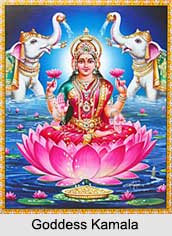
 Goddess Kamala is one of the Ten Mahavidyas who is known as the Wisdom Goddesses. She is also the Hindu Goddess of consciousness and creation. Goddess Kamala is also considered the most beautiful Mahavidya. She is the form of Goddess Lakshmi which relates specifically to the practice of Yoga. Hence she is also a form of Goddess Kali.
Goddess Kamala
Goddess Kamala is one of the Ten Mahavidyas who is considered as the bestower of Good luck, wealth, power and security.
Introduction
Goddess Kamala is one of the Ten Mahavidyas who is known as the Wisdom Goddesses. She is also the Hindu Goddess of consciousness and creation. Goddess Kamala is also considered the most beautiful Mahavidya. She is the form of Goddess Lakshmi which relates specifically to the practice of Yoga. Hence she is also a form of Goddess Kali.Origin of Goddess Kamala
 Kamala is the Hindu Goddess of consciousness and creation. She is one of the Ten Mahavidyas, the wisdom Goddesses. Kamala is the first and most primal female energy. More developed, she takes on the other qualities of the other Mahavidyas.
Early references of Goddess Kamala address her as Sri. They relate her to all the positive qualities and energies. The word Sri means, `auspicious.` The Satapatha- Barahmana relates her with food, royal power, luster, fortune and beauty. The Sri- Sukta which is an early hymn that dates back to pre- Buddhist times elaborately reflects her positive qualities and auspicious nature. The goddess is considered as the bestower of wealth and other desired objects to her devotees. The goddess is adorned with costly ornaments and is associated with fertility and growth.
Sri- Sukta also associates Sri with the lotus and the elephant. These proved to be both central and essential in her subsequent history and reflect significant aspects of her character. The lotus that the goddess bears has two general meanings. First, it is associated to life and fertility. On a cosmic scale the lotus represents the entire universe created by Gods. The cosmos like the lotus advocates a world that is organic, dynamic and attractive. It is the fecund vigour suggested by the lotus that is revealed in Sri. She is considered as the life force that pervades creation.
In connection to Sri, the lotus suggests spiritual purity, power and authority. In the Hindu and Buddhist iconography the lotus seat is considered as a common theme. Gods and Goddess, Buddhas and Bodhisattvas have been seen seated or standing on a lotus. Like the lotus which is rooted in the mud but whose blossoms are uncontaminated by it, these spiritual beings are understood to transcend the earthly limitations of the world. Sri`s association with the lotus suggests that she symbolizes a certain perfection or state of refinement that transcends the material world, it is rooted in it.
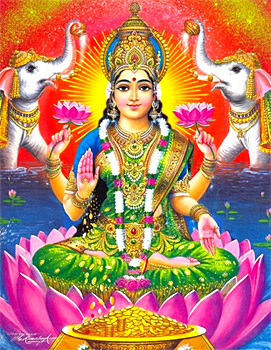
Sri`s association with the elephant relates other prospects of her character that are ancient and persistent. One of the most widespread images of Sri depicts her flanked by two huge elephants that shower her with water from their trunks. The elephants represent two meanings. In Hindu tradition, elephants have been related to clouds and rain and hence they signify fertility. Second elephants stand as royal authority. In ancient times kings and emperors used to keep stables of elephants. They used to ride them during processions and also used them in military campaigns. Kings were also held responsible for bringing timely rains and for the fertility of the land generally, their possession of elephants is probably related to that role too.
Iconography of Goddess Kamala
Goddess Kamala is represented as a beautiful woman adorned with golden skin and seated or standing on a lotus. She wears a dazzling crown on her head and puts on a silken dress. She also wears a Kaustibha Gem and has a smiling face. The goddess is seen seated on a lotus in a Padmasana or lotus posture.
Kamala Goddess has four hands. In her two hands, she holds two lotuses. These are symbols of purity and fertility. Her other two hands are in Abhaya Mudra or the gesture of giving assurance and Varada Mudra or gesture of conferring boons respectively to her devotees. She is also seen holding two more lotuses that symbolize of both fertility and purity. The goddess is being bathed by two or four large elephants. Elephants pouring nectar onto her are symbols of sovereignty and fertility.
Kamala Goddess has four hands. In her two hands, she holds two lotuses. These are symbols of purity and fertility. Her other two hands are in Abhaya Mudra or the gesture of giving assurance and Varada Mudra or gesture of conferring boons respectively to her devotees. She is also seen holding two more lotuses that symbolize of both fertility and purity. The goddess is being bathed by two or four large elephants. Elephants pouring nectar onto her are symbols of sovereignty and fertility.
Worshipping of Goddess Kamala
Goddess Kamala is also widely known for her creative force. She has the power to create beauty and wealth around us, and to see the beauty in everything. As the goddess of material and spiritual wealth and beauty, Kamala is worshipped during tough economic times. The Bija Mantra or the seed mantra of the goddess is "EEM" or "Om Shrim Shrim Kamalatmika Shrim Swaha". This is the primal "Shakta Beej" and is sometimes named as "Yoni Beej". Yoni is in the form of a female"s sex organ and is in form of a lotus. It is the most basic female principle. She is the benign goddess who blesses her devotees with good luck, power, wealth and safety.
Recently updated articles in Religion in India
Kusumayudha
Kusumayudha is a name of Kamadeva, the Hindu God of Love. Depicted with a sugarcane bow and flower-tipped arrows, he represents attraction and longing...
Bhoyar Caste
Bhoyar Caste is largely found in the Central Provinces of the country. Traditional occupation of Bhoyars is agriculture. They are good cultivators and...
Chasa Caste
Chasa caste is a prominent agrarian community native to Odisha. Traditionally associated with cultivation and farming, Chasas have historically played...
Vigneswara, A Form of Lord Ganesha
Lord Vigneswara is another form of Lord Ganesha or Vinayaka, prominently worshipped as the God of intelligence and good luck in the Indian subcontinen...
Maheswara
Maheswara, meaning “the Great Lord,” is a revered name of Lord Shiva in Hindu tradition. It represents Shiva’s supreme authority over creation, preser...
Related articles in Religion in India

Religion in Indus Valley Civilization
Religion in Indus Valley Civilisation included Hinduism, Buddhism and Jainism. Details about the religion in Indus Valley Civilization have been gathe...

Iyer Brahmin
Iyer Brahmins are originally from Tamil Nadu of South India. They are known for their adherence to Advaita philosophy and Smarta traditions. Tradition...

Kumbhakar / Kumhar Caste
Kumbhakar or Kumhar caste is a traditional artisan community in India known for pottery making. Derived from Sanskrit word Kumbhakar, meaning potter,...

Gujjars in Mughal Era
Gujjars in the Mughal era enjoyed great power. Further their power increased with the decline of Aurangzeb, Mughal emperor.

Gotra in Hinduism
In Hinduism, gotra refers to a lineage system tracing descent from ancient sages, primarily through the paternal line. Originating from Vedic traditio...