
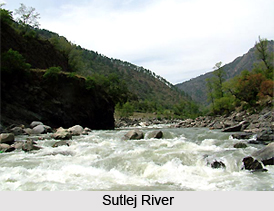
 Ferozepur District is situated at India Pakistan border with its headquarters at Ferozepur. At the east side of this district, Faridkot District, Moga District and at its southern side Muktsar District is situated. On the north east side, Sutlej River generally separates Ferozepur District and Kapurthala District and on the south west side Ganganagar District of Rajasthan touches the boundaries of Ferozepur District. The united stream of the Sutlej and Beas rivers generally separate it from Amritsar District in the north-west.
Ferozepur District
Ferozepur District of Punjab is defined as the land of martyrs. Owing to its strategic location between north – western frontier and the main land, Ferozepur District witnessed many battles and the frequenting invaders.
Introduction
Ferozepur District is situated at India Pakistan border with its headquarters at Ferozepur. At the east side of this district, Faridkot District, Moga District and at its southern side Muktsar District is situated. On the north east side, Sutlej River generally separates Ferozepur District and Kapurthala District and on the south west side Ganganagar District of Rajasthan touches the boundaries of Ferozepur District. The united stream of the Sutlej and Beas rivers generally separate it from Amritsar District in the north-west.History of Ferozepur District
According to the history of Ferozepur District, it is believed to have been founded by Firoz Shah Tughlaq in the 14th century AD. Another historical version claims that it was founded by a Bhatti chief called Feroze Khan. However, the first version of the history of Ferozepur District is more widely accepted as Firoz Shah Tughlaq had a passion for building new cities and renaming old ones especially after his own name. Ferozepur District`s strategic position in the northwest of the country has resulted in its being part of many military expeditions in the area. Ferozepur District is deeply associated with the freedom struggle of India. Little is known about the ancient history of Ferozepur District as it finds no mention in the early records. The origin of the present villages and towns can be traced from the region of Akbar only. The relics of antiquity, that might have existed, have been washed away as the area was submerged several times by the river Sutlej. The large mounds of earth and the debris of bricks or pottery, called `thehs` , often along the upper bank of the river bank was inhabited in the ancient time. Probably this region was occupied by Malavas and Kshudrakas in the early period of history.
Geography of Ferozepur District
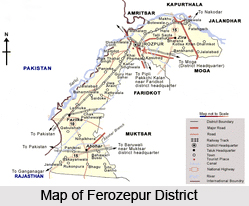 Geography of Ferozepur district is even. The total geographical area of Ferozepur District is 5303 sq kms. It is a plain area of alluvial formation sloping gently from the north east to the south west. The district is divided into three main belts running almost parallel to the course of river Sutlej. On south west side, the bet area called `Hittar` having dark gray clay intermixed with straits of sand. On the South East side, the Rohi and Mukhi Plains have light and sandy soil and brackish water in wells. The district has two types of soils, namely, alluvial soil (69 percent) and desert soil (31 percent).
Geography of Ferozepur District is characterized with a dry climate. It includes a very hot summer, a short rainy season and a healthy winter season. A seasonal year has four divisions. The cold season is from November to March, followed by the summer season which lasts up to the end of June. The period from July to mid-September constitutes the south-westerly monsoon season. The latter half of September and October may be termed as the post-monsoon or the transition period. From about the end of March, the temperature increases rapidly till June which is generally the hottest month and on individual days, the maximum temperature reaches up to 47 degree Celsius. However, with the onset of the monsoon by the end of June or early July, there is an appreciable drop in day temperature but the weather remains oppressive due to the increased moisture in July and August. By about the second week of September both day and night temperatures begin to fall, the drop in the night temperature being more than the day temperature. After October, both day and night temperatures decrease rapidly till January, which is the coldest month when the minimum temperature occasionally drops to about a degree of two below the freezing point of water.
Rainfall in Ferozepur District generally increases from the south-west towards the north east. About 70 percent of the annual rainfall in the district is received during the period from July to September, July and August being the rainiest months. Some rainfall occurs during the pre-monsoon months, mostly in the form of thunder showers. In the winter season, some rainfall occurs under the influence of westerly disturbances. However, the variation in the rainfall from year to year is huge.
Tourism in Ferozepur District
 Tourism in Ferozepur District is dotted with a number of holy shrines, historical places and memorials in and around it. One may assume it as the most unlikely place for a tourist to visit but it has many pleasant surprises for the travellers. In the past, Ferozepur town was surrounded by a circular wall with many gates like Delhi Gate, Mjori Gate, Baghdadi Gate, Zira Gate, Makhu Gate, Bansanwala Gate, Amritsari Gate, Kasuri Gate, Multani Gate and Magazine Gate. Out of these Baghdadi and Multani Gates still exist.
Some of the main attractions of Ferozpur District are as follows -
Pilgrimage Tourism in Ferozepur District :
Gurudwara Gurusar: Gurudwara Gurusar, built in the memory of Guru Gobind Singh at Bazidpur, situated 7 kms from Ferozepur cantonment. It is said that the Guru rested at this place on his way after the battle of Muktsar. A big fair is held here on Vasant Panchami.
Shwetamber Jain Temple: The majestic Shwetamber Jain Temple at Zira, 36 km from Ferozepur, is worth visiting. Built on 1980, the temple is dedicated to Parsavanath. The life of Jain Tirthankaras is depicted through paintings on the walls of the temple. The brass idols in the temple are older than twelve hundred years and the main idol, which was brought from Palitana in Gujarat, is believed to be very old and sacred.
Leisure Tourism in Ferozepur District :
Anglo Sikh War Memorial: Anglo Sikh War Memorial was constructed by the state government of Punjab to perpetuate the memory of the brave martyrs who laid down their lives for the independence of the country. This is one of the major tourist attractions of Ferozepur District with great historical importance. The memorial was built to immortalize the irrepressible revolutionary spirit of three martyrs. On 23rd of March every year a fair is held at this place and thousands of people gather here to pay their homage to the great martyrs who made sacrifice for the sake of the country`s freedom.
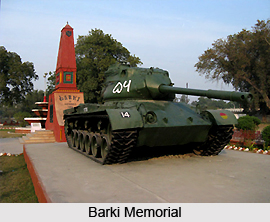 Barki Memorial: Barki Memorial was constructed in 1969 to perpetuate the memory of the soldiers of the 7 Infantry Division who made the sacrifices on the battle field in 1965 and paved the way for the fall of Barki a town situated at a distance of 15 miles south east of Lahore. The foundation stone of this memorial was laid in the year 1969. The memorial which now forms a part of Saragarhi Complex has a pillar in the centre, a Patten tank and a Barki mile stone in the south and a water fountain in the North The pillar is 27 feet high and is built of red and white sand stone. The relief carvings are in classical Indian architectural style. The fountain denotes symbolically that the memory of those who laid down their lives will for ever remain green and lush by an abundant spray of water.
Saragarhi Memorial: Saragarhi Memorial Gurudwara was built to commemorate the heroic martyrdom of 21 soldiers, who died without surrendering to the enemy in defence of Saragarhi post of Baluchistan on 12th September, 1897. The Gurudwara, circular in shape and located in a well laid out park, is unique for its marvelous style of architecture. Every year on September 12, the Saragarhi Day is celebrated and thousands of people flock here to pay tribute to the heroic soldier.
Ferozepur Cantonment: Ferozepur Cantonment, one of the oldest cantonments, was established in 1838 by Sir Henry Lawrence, who was posted here as the Assistant Political Agent. Today it is proud to be one of the oldest Cantonments of the country with an invaluable and enviable heritage of buildings, both of historical and architectural importance like Saragarhi Memorial, Barki Square, Mamdot Fort, Anglo Sikh war memorial to name a few. The Fort in the Cantonment was constructed in 1810 in an area of 65 acres. The British occupied this fort treacherously and converted it into a garrison in 1839. Surrounded by a huge stone wall, a big bund made of mud and a deep trench, the fort now houses some army units including the ordnance unit. Most of the massive building and the magazine constructed by the British inside the fort are still intact.
Indo - Pak War Memorial: The Indo - Pak war memorial, built by Punjab Government in 1976, is located at Ferozeshah, 16 kilometer from Ferozepur at Moga Road. The memorial was built in memory of the Sikh warriors who laid down their lives in the First Anglo - Sigh war on 18th December, 1845 at Ferozeshah on 21st December, 1845 and at Sabrao on 10th February, 1846. The Sikhs lost the war because of treachery of their Generals.
 Nature Tourism in Ferozepur District :
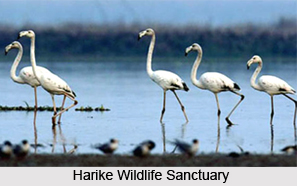
Harike Wildlife Sanctuaries: Harike is one of the most important Wild Life Sanctuaries of the country. Situated on the confluence of the Beas River and Sutlej River at Ferozepur and Amritsar border the sanctuary encompass an area of approximately 86 sq km. The area was declared as a Wild Life Sanctuary in 1999 and because of its importance as a wetland of international stature. The sanctuary is considered as a bird watchers paradise and attracts thousands of migratory birds during winter, some from as far off as Siberia and the Arctic. It is a refuge for a large number of resident and migratory birds. Some 45,000 ducks have been recorded here during the peak migratory season.
Apart from these attractions Chak Sarkar Forest and Wildlife Sanctuary in Abohar are the other places of interest. All these tourism options are worth visiting and they attract people from all corners of the country.
Recently updated articles in States of India
Bandare Waterfalls, Meghalaya
Bandare Waterfalls in South Garo Hills, Meghalaya, is a secluded natural attraction surrounded by dense subtropical forests and rugged mountain terrai...
History of Thissur District
Early History of Thissur District explains flourishing of the port cities. Now these port cities are transformed into archaeological sites.
Tippi Orchid Research Centre, Arunachal Pradesh
Tippi Orchid Research Centre in Arunachal Pradesh is renowned for its rich collection of exotic and endangered orchids. Surrounded by lush rainforest...
Tourism in Nashik District
Pilgrimage tourism in Nashik district involves visiting the various places of Hindu and Jain worship located here. Some of the holiest sites for Hind...
Mangadu, Kerala
Mangadu in Kerala’s Kollam district is a significant megalithic site known for its urn burials, cist burials, menhirs, and stone circles. Excavations...
Related articles in States of India
East Indian States
East Indian States comprises of Bihar, Jharkhand, West Bengal, Odisha and also the Union Territory of Andaman and Nicobar Islands. It defines the cult...
Purnia District in Bihar
Purnia District is located in Bihar and extends from River Ganga to Nepal. The district has a rich Hindu history and glorious past.
Hooghly district
Hooghly District along the bank of the river Hooghly is one of the principal trading ports of West Bengal.
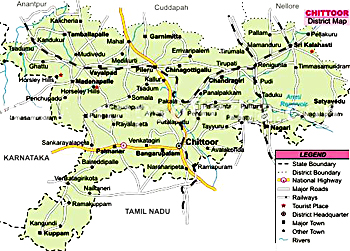
Geography Of Chittoor District
Geography of Chittoor district is spread along the topography of the land which is divided into two natural divisions; Chittoor has a dry and healthy...

Districts of West Bihar
Districts of West Bihar is comprised of medieval monuments that were built by the different governors of Mughal era.