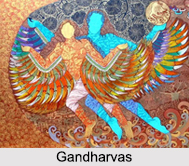
 Gandharvas are the spirits of the air, forests and mountains and the male counterpart of the Apsaras. Each Gandharva has a different distinct description. Sometimes they are shaggy, damp and dirty creatures who are partly man and partly animal. In other times they are the males with the wings and legs like a bird.
Gandharvas are sometimes centaur-like with a half man and half horse appearance. Sometimes they are also narrated as fair men with emasculate features. They are expert at musical skills; they are capable to direct illusions and have the skill of riding horses. They can also fly. Gandharvas are also presented as the guardians of the eminent "Somarasa" (juice) in the court of the Gods. They were the successors of Kashyapa and his wife Arishta.
Gandharvas in Vedas
Gandharvas are seen to live on trees, such as the banyan and the sacred fig, and are implored to sanctify the wedding demonstrations. The Gandharvas are the escorts of the Apsaras. Gandharvas were the original proprietors of the Somarasa (juice). They sold the Somarasa to the gods in exchange for a goddess - the goddess Vach (speech), because they are very fond of female company. Some scholars trace the beginning of the gandharvas to the Indo-Iranian period because the Avesta (Vedic language) holds the references to a similar being called "Gandarewa" who lives in the sea of white Haoma (Somarasa).
Gandharvas as Nature Spirits
The term "gandharva" is to signify an entire race of male nature spirits, 60 million in number, who according to the Vishnu Purana, were the sons of Lord Brahma, the creator deity. Meanwhile, the "Padma Purana" considers the gandharvas to be children of goddess Vach (speech). The natures of the Gandharvas are changeable. Gandharvas have unique healing powers and are identified in the Rig Veda as the physicians of the gods.
In some parts, Gandharvas are animal; often their face was that of a bird. The Gandharvas upheld a powerful competition with another group of nature spirits, the Nagas (mythological race of snake-like deities). As such, Gandharvas regularly filled the role of performers in the divine courts, appearing at banquets and other special events to create beautiful music for the gods while the Apsaras danced along. Gandharvas also come out in a similar function at other events of mythological implication.
Notable Gandharvas
The distinguished gandharvas are Panada, Opamanna, Nala, Chittasena and Raja. Janesabha is possibly the same as Janavasabha, a rebirth of King Bimbisara of Magadha. Timbaru (Tumburu) was a tribal chief of the gandharvas.
Gandharva or gandhabba is also used in an entirely different sense, referring to a being in a luminal state between death and rebirth. The Gandharvas generally had their residence in the sky.