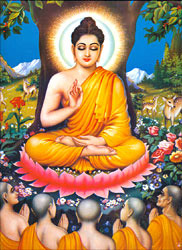
 When Gautama Buddha attained enlightenment he first met two merchants named as Tapussa and Bhallika, who became his first disciples. Buddha gave them some hair from his head, which are now said to be enshrined in Shwe Dagon temple located in Rangoon, Burma.
Buddha then wanted to visit Asita and his former teachers Alara Kalama and Uddaka Ramaputta to explain what he found through Dhyana, but all of them had already died. Buddha then reached Deer Park (Mrigaban) near Varanasi. Here he reunited with his five companions with whom he started his journey to enlightenment. Buddha delivered his first sermon to them and set in motion the `Wheel of Dharma`. They along with Buddha formed the first Sangha, the company of Buddhist Monks and thus the formation of the Triple Gem (Buddha, Dharma and Sangha) was completed. Kaundinya became the first stream-enterer. All the five companions soon became arahants. Then Yasa came with fifty-four friends and all of them were converted to Buddhist religion. Thus the total number of Arahants became sixty within the first two months of beginning of Dharma Chakra. Then Three Kasyapa brothers underwent conversion with their two hundred, three hundred and five hundred disciples. Thus total member of Sangha became more than thousand and the Arahants were dispatched to various places to propagate the Buddhist religion to the common people.