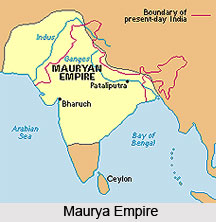
 After consolidating his empire in the extensive tract of land stretching from Magadha to Bengal in the east to the Hindukush Mountain in the northwest, he set out for the conquest of the vast tract of western India. According to Bongard Levin, Chandragupta due to his alliance with Selucus, could receive opportunity of paying stern attention to the domestic affairs and his conquests in other parts of India. However the classical writers do not provide any detail about the conquest of Chandragupta Maurya in other parts of India. Plutarch only remarks that with an army comprising six hundred thousand, Chandragupta overran and subdued the whole India. Chandragupta annexed the province of Saurashtra, as is proved by the Girnar rock inscription of Rudramana I. The Girnar rock inscription refers to Pushyagupta, the High commissioner of Chandragupta in Saurashtra. Historical evidences indicate that Pushyagupta constructed the lake Sudarshana in Saurashtra. Some scholars have also opined that Chandragupta had also annexed the neighbouring kingdom of Avanti, because historical records point out Ujjaini, the capital of Avanti as the seat of Maurya Viceroyalty. Jain records also are in line with the historians point regarding the annexation of Avanti. The discovery of the Ashokan rock edict in Sapora, Maharashtra testifies that Chandragupta had established the banner of his victory in the region of Maharashtra. Historical evidences point out that Chandragupta during his reign became the sole master of Saurashtra and probably also of the Avanti and Konkan coast of Maharashtra.
According to historians, Chandragupta Maurya, while campaigning an extensive conquest in the entire north India, was however not unmindful of the south. However Chandragupta was credited to have unified the major parts of India. Though the Southern conquest of Chandragupta is still a subject of keen controversy among the historians, still they have unanimously opined that Chandragupta Maurya dreamt of political unification of India under his own authority. In the opinion of V.Smith, Chandragupta had emerged from obscurity and was busy to climb up in power since the initiation of his career. Henceforth he did not have time to expedite in the southern states of India. According to Smith the conquest of south was probably the campaign of Bindusara. However scholars refuted Smith`s point on the ground that Bindusara was an epicure with much passion for dried figs and sweet wine and an indolent ruler like him might never have taken interest in conquest and extension of empire.
However the classical writers and the indigenous scholars agree on the point that the extension of the Maurya Empire to the southern states was ascribed to Chandragupta Maurya. Chandragupta`s extension of the Mauryan Empire to the areas of Mysore and Nellore is assured by the discovery of the Rock Edicts XIII and II in these regions. Since Ashoka in his lifetime was successful only one conquest of Kalinga and Bindusara is left out of question, it is unmistakably true that the credit of the conquest of south India goes to Chandragupta Maurya. Secondly, since the Nanda Empire stretched to the regions of Godavari, it is explicit enough that Chandragupta Maurya, during his campaign against the Nandas, might have occupied the regions around Godavari. Again the Arthashastra of Kautilya mentions about the brisk trade between north and south during the Mauryan period, which indicates that the entire southern region was under the sway of Chandragupta Maurya. The Tamil poet Mamulanar, who flourished four centuries after the fall of the Mauryas, recorded that the Maurya upstarts advanced upto the Tinevalley district from the Konkan coast. The term "upstart" is significant enough since Chandragupta Maurya had risen from absolute obscurity. Finally, the Jain traditions also associate the name of the first Mauryan king Chandragupta Maurya with the Mysore country.