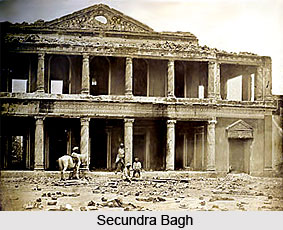
 Lucknow Residency was previously endeavoured to be relieved from the native fighters by incredible efforts of British army officials, Havelock and Outram. Though they had gained a partial victory, yet bulk of the massive structure remained unoccupied. The native rebellious soldiers had devised out a foolproof plan to nonplus the Britons. Heavy shelling had left the rulers disturbed. A second attempt was thus being made to occupy the Residency, under the gallant efforts of Sir Colin Campbell, Adrian Hope, Hope Grant, several other capable officers, and of course, Outram.
The Alambagh had already been captured after considerable plannings by the generals. After Sir Colin`s advice, troops and batteries were deployed towards Sikandarabagh to conquer it. A terrible bloodbath was ensuing in the garden (bagh). The native troopers had almost given way under tremendous pressure of firing resorted to by Blunt. The after-effects of the second relief were yet to make itself manifest.
As this bloody scene was being enacted at the Sikandarabagh, a detachment of the same brigade had captured the large building known as the Barracks. Captain Stewart of the 93rd had greatly distinguished himself. Then Sir Colin made preparations to storm the Shah Najaf mosque. It was a massively built mosque in the direct road to the Residency, situated in a garden surrounded by very strong loopholed walls.
It was at the Shah Najaf that the rebels had considered stopping the British advance. They almost succeeded. For three hours the front attack made no way. Worse still, the road along which the force had advanced became so jammed that retreat by it was impossible. All this time the troops were exposed to a deadly fire of heavy guns and musketry. From other points, too, heavy guns were brought to play upon the bemused English soldiers. A shot from one of these blew up one of Peel`s tumbrils. The men were falling fast. Sir Colin sat on his white horse, exposed to the full fire of the enemy. His gaze was bent on the Shah Najaf, upon whose solid walls not even the heaviest guns could make an impression. As a last resource he collected the 93rd about him, and told them that the Shah Najaf must be taken. In carrying out this necessary work Sir Colin would go with them himself.
But neither the dashing gunners of Middleton`s battery, nor the daring of the Highlanders and the Sikhs, the persistent fire of the heavy guns of Peel, could achieve the desired end. Shah Najaf bemused them all. Evening was fast approaching. Success seemed impossible. Then Adrian Hope, collecting some fifty men, stole silently and cautiously through the jungle to a portion of the wall. A sergeant of his had detected a weakness on that portion of the wall. On reaching it unperceived, Hope found a narrow fissure there. With great difficulty, a single man was pushed up. He helped up others. More men were sent for. Then those who had entered moved forward. The surprise to the rebels as these men advanced was so thorough that they did not resist but evacuated the place. The fight was then over. Adrian Hope`s victorious stormers had but to open the main gate to their comrades outside.
 The British force halted there for the night. The occupation of the Shah Najaf mosque had rendered certain success for the upcoming day. The conduct of Cooper, Ewart, Lumsden, and the privates Dunley, Mackay and Grant at the Sikandarabagh; of Stewart at the Barracks; of Sergeant Paton, who first pointed out to Adrian Hope the weak point in the wall of the Shah Najaf; of Adrian Hope himself; of Blunt, who made possible the attack on the Sikandarabagh; of William Peel, of Travers, of Middleton, of Bourchier, of the two Alisons, of Anson, and of many others gave ample proof of gallantry and audaciousness for the British to stand tall against their intimidating foe.
The next morning the force, thoroughly refreshed by sleep, advanced to complete its work. To reach the Lucknow Residency the troops had yet to carry the mess-house and the Moti Mahal. They had to accomplish this while the guns of rebels were posted in the Tara Kothi and the Kaisarbagh, playing on their left flank. To secure his left Sir Colin detached the 5th Brigade, under Russell. The brigade`s aim was to seize Banks`s house and four bungalows close to the Barracks and to convert them into military posts. By this process Colin`s left rear would be secured. His retirement with the `impedimenta` (baggage and equipment carried by an army) from the Residency was also made safe. He then proceeded to cannonade the mess-house.
No sooner had the musketry fire of the enemy been completely silenced, than the order to storm the place was given. This feat of arms was most gallantly achieved by Captain Hopkins of the 53rd, who carried the place with a rush. He had just reached the entrance when Roberts, the Commander-in-Chief in India, handed him a Union Jack (the national flag of the United Kingdom) and requested him to hoist it on one of the turrets. Hopkins, assisted by one of his men, did this twice in succession. The Jack was shot down twice. Hopkins was about to hoist it the third time when he received an order from Sir Colin to desist. The flag was attracting the attention of the enemy too earnestly. In an equally gallant manner Captain Garnet Wolseley had carried the houses to the right of the mess-house. Pushing on his enterprise, Captain Wolseley had stormed the Moti Mahal. It was a grand feat.
An open space, almost half a mile in width, still intervened between the assaulters and the advanced posts of Outram and Havelock. On this space the fire of the guns from Kaisarbagh played with uninterrupted fury. To cross it was to run a great risk. Outram, Havelock, Napier, Vincent Eyre, young Havelock, Dodgson, Sitwell, Russell, and Kavanagh attempted it. They did not all pass the ordeal unscathed. Napier, young Havelock, Sitwell, and Russell were struck down. The others reached the Moti Mahal unharmed. Then, to use the language of Sir Colin, `the relief of the garrison had been accomplished.`
The conversation between the Commander-in-Chief and his visitors was short. When it was finished, the visitors again had to traverse the terrible space. Sir Henry Havelock, leaning on Dodgson, could, from the weak state of his health, walk but slowly. Yet, amid the continuous storm of bullets the two returned unscathed. It was Havelock to whom Outram had consigned the task of working out towards the relieving force. Outram wanted to give it a hand as soon as the mess-house and Moti Mahal should be carried. And right well had the gallant veteran, i.e., Havelock, performed the task allotted to him.
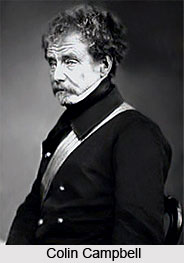 It remained now to Sir Colin to formulate a plan for the withdrawal of the women and children. It was no simple task even after he had by his advance made a way for the movement. It seemed to him, at first, absolutely necessary to quieten the fire of Kaisarbagh. The plan he adopted was the following.
On the first day of the advance Sir Colin had directed Russell to occupy Banks`s bungalow and the bungalows adjoining. This had been exercised. But to complete the communications it was necessary also to seize a building known as the Hospital, between the bungalows and the Barracks. In attempting to take this Russell was wounded, and Biddulph was killed. Hale, who succeeded, though he took the Hospital, was unable to maintain himself there. While this attack was progressing, the rebels, gathering heart, attacked the pickets between the Barracks and the Sikandarabagh in substantial force. They were rebuffed after some hard fighting in which Remmington and his troop covered themselves with glory.
The line of retirement by Banks`s house proved quite difficult and dangerous. Sir Colin then surveyed the ground between the positions actually held by the British and the canal. He finally resolved to move by that. Colin carried out the operation on the 20th and four following days. Turning the fire of William Peel`s heavy guns on the Kaisarbagh, he led the rebels in that direction to expect an assault. Thus, he moved the women and children from the place in which they had been so long defended. On the evening of the 22nd November, Sir Colin had them safely landed in the Dilkhusha. Hale, who commanded the rearguard, joined him there on the 23rd. On the 24th, while he was halting, though not resting there, the gallant Havelock passed away. He had indeed fought a good fight. He had died as he had lived, in the performance of his duty. On the 26th November, the noblest of his comrades followed his remains to his grave in the Alambagh.
That place had been reached on 25th November itself. There Sir Colin made a fresh distribution of his force. He left Outram, with rather less than 4000 men, at the Alambagh, threatening the still rebellious Lakhnao (Lucknow). While, he himself returned to look after Windham at Kanhpur (Kanpur). About that place he was very anxious, for he had no news. The reports he had received were to the effect that heavy firing had been heard in that direction. On the 27th, then, at eleven o`clock in the morning, Sir Colin started for Kanhpur (Kanpur). He slept at Banni and started early the next morning on his forward march towards the Ganga River. On his way he received despatches which showed him that the place was in an immense state of threat. At Mangalwar he halted his troops and fired three fusillades to announce his approach. Then, Colin galloped forward with his staff, in mixed fear and hope as to the state of the bridge of boats. To his joy he saw, by the pale evening light, that it was undamaged. Vast sheets of flames, arising from burning buildings showed to him as clearly that the rebels must have beaten Windham and occupied Kanhpur (Kanpur).