 Simplicity and asperity were the main characteristics of the Islamic architecture. The composition of lines and angles was uppermost in an Indian architect`s mind. Another important feature of Indian architecture was the exuberance of sculpture decoration. The impact of Islamic architecture is most visible in the buildings of the North where the Saracenic emphasis on harmony and form is blended with Indian emphasis on splendor and decoration.
There were three important factors, which led to the amalgamation of the foreign and indigenous styles of architectures. And these can be mentioned as (1) the Muslim rulers had to employ Indian architects and masons, (2) the early Muslim rulers used the material of Hindu temples in making their mosques and tombs and (3) some Muslim rulers converted Hindu and Jain temples into mosques, by making necessary alterations.
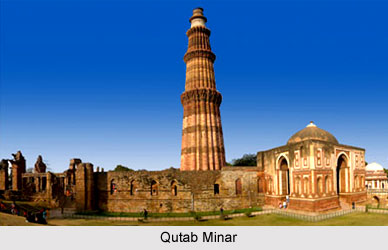
Soon after the conquest of north India the Muslims started building imposing mosques and minarets. They did so not only to provide for their religious needs but also as symbols of conquest for impressing the Indians with the majesty of their power. The earliest buildings of the Slave dynasty were the great Quwwat-ul-Islam mosque with the magnificent Qutab Minar at Delhi and the Qutbi mosque at Ajmer. These two are evident out of the materials that became available from the demolished Hindu and Jain temples. The Muslim conquest spread many mosques, forts, palaces, etc., in Delhi and also in provincial capitals.
The Hindu system of construction was based on column and architrave whereas the Muslims in India employed arches and vaults. Strength and grace were the outstanding characteristics of Hindu architecture. The earlier buildings of the Sultanate period at Delhi bear a definite stamp of the traditions of Hindu architecture. Buildings of a later date, however, are marked by their breadth and spaciousness. Pendative and squint arches domes, minars, half domed double portals are characteristic of these buildings. In short, this period marked the evolution and development of a new-type of Hindu-Muslim architecture in which the simple severity of the Muslim architecture was toned down. The plastic exuberance of the Hindu was restrained. Some common features of Hindu temples were the craftsmanship, ornamental richness and general design. On the other hand, the arches, the domes plain walls and spacious interiors were features of Muslim architecture.
 Fatehpur Sikri and the tombs of Akbar and Itmad-ud-Daula remain specimens of an imperfect fusion. Taj Mahal is a living monument of the perfect synthesis of the Islamic and Indian styles of architecture as well.
The influence of Saracenic style is visible not only in the monuments but also in the utilitarian works. As for example houses, streets, bathing places and even in the places of worship.
The spirit of synthesis, which manifested itself in many spheres, was best expressed in the field of architecture. The distinctive features of the Muslim architecture were massive and extensive buildings impressive domes, tall minarets, lofty portals, open courtyards and massive walls bereft of sculpture. The Hindu architecture was often characterized by stability, majesty, magnificence, sublimity and infinite richness. As a result of the synthesis of these two styles a new style of architecture developed which is called Indo-Muslim architecture.
Music
By combining the Indian Veena and the Iranian Tambura, Amir Khusrau (1253-1325) was able to produce the Sitar. The tabla is nothing but a modification of Indian Mridanga. A fusion of Hindu and Iranian systems led to the evolution of light songs, like qawwali instead of only classical strains. Now a day these types of music are very prominent.
There were a large number of musicians attached to Akbar`s court. The name of the chief musician of that court was Tansen. During Akbar`s reign ragas were considerably modified under foreign influence. They were on the whole to the advantage of music and helped to give northern music some of the more pleasing characteristics. Music continued to flourish during the reigns of Jahangir and Shahjahan.
Painting
The Indo-Saracenic school of painting is one of the richest contributions to Indian culture. It showed Chinese influence in many cases. Intense individuality, proper spacing and symmetry were the characteristics of Chinese art. In India these Chinese characteristics were rapidly dropped. The scenes and features were indianized as well. It also led to the development of a number of sub-styles such as the Rajput and Pahari styles, which were greatly influenced by ancient Hindu ideals. The Deccan, Lucknow, Kashmir and Patna styles of painting had predominantly of Muslim characteristics.
Not only talented Persian artists, like Mir Saiyed Ali of Tabriz and Khwaja Abdus Samad of Shiraz, but Hindu artists such as Daswanath, Basawan and others were trained to execute miniatures for the illuminated manuscripts of Zafarnama, Razmnama, etc. Painting of portraits, scenes and animals reached their zenith during Jahangir`s reign. By that date two main schools of painting, the Mughal and the Rajput, could be distinguished. The Mughal School is also called Indo-Persian whereas the Rajput school is essentially Hindu in expression. Both these schools, however, were influenced by one another, and as in the case of architecture, a synthesis of the two schools was gradually brought about.