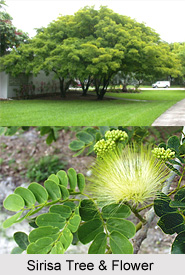
 Sirisa is a tree well known in the Indian subcontinent for its range of uses. Although geographically widespread, little is known about the species outside India. East India Walnut or Sirisa is probably native to tropical mainland Asia from Pakistan to Myanmar (Burma) but widely introduced as a garden or roadside ornamental and naturalized in many tropical and northern subtropical countries worldwide. It is common throughout India, from the plains up to 900 m elevation in the Himalayas. Sirisa is a species of "Albizia" and is widely cultivated and naturalized in other tropical and subtropical regions. Being one of the most widespread and common species of Albizia worldwide, it is often simply called "Siris".
Different Names of Sirisa
"East India Walnut" or "Sirisa" is commonly known as "Sirisha" in Bengali, Hindi, Marathi and Sanskrit and "Kattuvaka" in Malayalam. The botanical name of the tree is "Albizia Lebbeck".
Characteristic Features of Sirisa
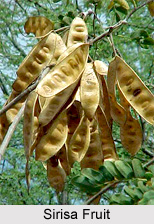
Sirisa is a large, unarmed, deciduous tree about 20 m tall with a spreading crown. The bark of the tree is pale, leaves are bipinnate, flowers are fragrant, white to greenish-yellow in colour, borne in globose umbellate heads, fruits are linear-oblong, bluntly pointed, thin, green turning straw-coloured on maturity and carry 4-12 pale brown seeds. Flowers come out from April to June and fruits mature in December in northern and central India; in southern India flowering occurs earlier, from January to April. In central India trees remain leafless for a month or more between March and June.
 Medicinal Values of Sirisa
In Ayurveda the astringent root of East India Walnut or Sirisa is used to treat hemicrania; the acrid bark is reportedly used to treat diseases of the blood, leucoderma, itching, skin diseases, piles, inflammation, erysipelas and bronchitis; the leaves are used to treat ophthalmia, and the flowers for asthma. In Unani medicine in India, the root is used to treat ophthalmia; the bark is regarded as anthelmintic and used to relieve toothache and to strengthen the gums and teeth, and to treat leprosy, deafness, boils, scabies, gingivitis, syphilis and paralysis: the leaves are reportedly useful for treating night blindness; and the seeds are used to treat gonorrhoea and tuberculosis glands, their oil applied locally for leucoderma. The flowers are used as a cooling medicine and as an external application to relieve boils, skin eruptions and swellings. The seed oil is used externally to promote healing of lesions in leprosy among the Irulars of Tamil Nadu. The powdered root bark and root-gum are used as a dental powder for strengthening the gums. It is used to treat cough, to treat the eye, flu, lung problems and pectoral problems, is used as a tonic, and is used to treat abdominal tumors. The bark is used medicinally to treat inflammation.