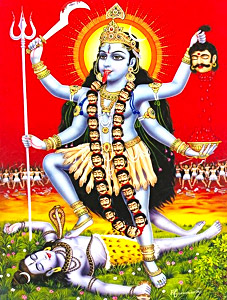
 The earliest references of Goddess Kali date back to the medieval period. Agni Purana and Garuda Purana worship Kali for victory in war. The goddess bears an awful appearance, sits on the back of a ghost and resides mainly in the cremation ground. In Bhagavata Purana Kali is patron deity of a group of thieves whose chief seeks to acquire her blessings in order to procure a son. The band even captured a Brahmin youth to offer his blood to the goddess but the effulgence of the youth instead burnt Kali. Infuriated Goddess Kali kills the entire group.
Kali has also been portrayed in Bengali Mangal Kavyas as bestowing magical powers upon thieves to help them out. The architectural work of the sixth to eighth century also bears evidence of Kali`s association with the Hindu society.
In Devimahaymya Kali`s appearance has been the most dreadful. The third episode of Devimahaymya features Goddess Durga defeat of the demons Sumbha and Nisumbha. Here Goddess Kali appears twice. Earlier the demons Canda and Munda approach Durga with weapons. Thus Durga becomes violent and goddess Kali springs from her forehead. Roaring loudly she leaps into the battle field and decapitates all the demons. Later Durga summons Kali to help her defeat Raktabija. The demon had the ability to reproduce himself from the drop of his own blood. Hence Kali defeats him by sucking his blood from his body.
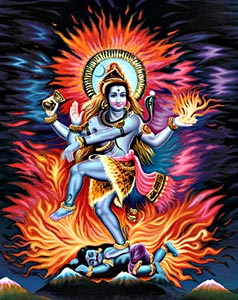
Goddess Kali also has similar encounter with Goddess Parvati. In Linga-Purana Lord Shiva asks Parvati to kill the demon Daruka who was blessed with the boon that he could only be destroyed by a female. Hence Parvati entered into Shiva`s body and transformed herself into Kali and finally defeats the demon. In Vamana Purana Shiva addresses Parvati as Kali because of her dark complexion. Kali thus makes similar appearances in myths concerning both Sati and Sita. In case of Sati Kali appears when her father Daksa infuriates her by not inviting Shiva in a sacrificial rite. Kali appears when Sati rubs her nose in anger. In case of Sita Kali approaches when Lord Rama is confronted with a terrible monster and kills the demon. Kali has always been associated with Shiva and in iconography she has always taken the dominant position.