 Dvija is a Sanskrit word which means one who is twice born .It is associated with first three varnas in Hinduism. Brahmins, Kshatriyas and Vaishyas, although in many Shastras, Dvija usually refers to Brahmin only.
The "stages of life for a twice born man"is discussed in details in the Hindu Manusmriti.The concept says that a member of the Dwija are to undergo four periods of life :first as a student Brahmacharya; then, as a householder Grihastha; then, he shall live in retirement Vanaprastha; and finally, as an ascetic Sanyasi.
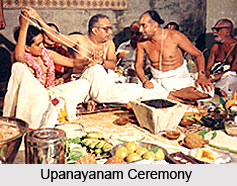
In the second stage of their life the boys belonging to these castes undergoes an initiation ceremony called upanayana, which allowed them to hear, study, and recite the Vedas, forbidden to sudras and women. Initiated members of the twice-born classes were distinguished by the sacred cord (yagyopavita, or, in Hindi, janeo), which they wore over their left shoulder and under their right arm and never removed it in their lifetime. This thread ceremony also called Upanayanam is assumed to be the second birth of the boy, when he is initiated into the ultimate pursuit of life Brahmopadesam (Preaching/Advising in the matter of the nature of Brahman - the ultimate reality) A Dwija is governed by his Karma and his conduct has to be a cultured one. His life is governed by Dharma-Adharma (right and wrong), Karya-Akaryam (good and bad deeds) and Vidhi-Nisheda (Prescribed and Proscribed actions) as determined by Sastra Pramana. A Dwija does what he ought to do rather than what he wants to do. He does not avoid what he dislikes rather he avoids what ought to be avoided.
The Upanayanam ceremony gave a student a new status of dvija or twice born which comprised of pledging in front of sacred fire under the supervision of a priest .The symbol of Upanayanam was a sacred thread which has to be worn around the body by the boy. The sacred thread would bind him symbolically to the vow and remind him of the vow he had taken throughout his life. It would remind him of the vow to adhere to the qualities of hard work, humility, kindness, politeness and honesty.
Dvija or twice born status signified being born in spirit and undergoing a spiritual growth and mental transformations. It had nothing to do with being physically reborn or exiting the womb twice. Similarly, dvija was not related in anyway to the previous birth or reincarnation. Upanayanam acted as a preliminary exercise for a decent behaviour required for sruti learning.
However merely undergoing the Upanayanam (initiation) ceremony, acquiring the dvija (twice born) status or having (wearing) the yagyopavit (sacred thread) around one`s body was not enough to become a true Brahmin .The process to become a Brahmin lay in completing the necessary education.