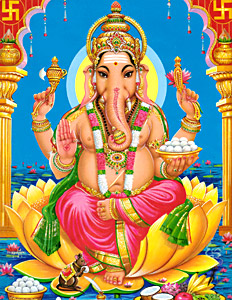
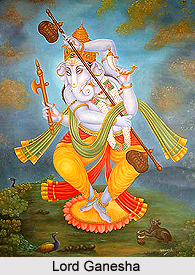
 Dvidehaka is one of the forms of Lord Ganesha. In the form of Dvidehaka, Lord Ganesha is portrayed in the composite form with the head of an elephant transplanted over a human body. According to the Shiva Purana, Lord Ganesha once prevented Lord Shiva from entering Mount Kailash. Shiva became angry and decapitated the noble child. Later, upon the suggestion of Lord Brahma, Lord Shiva attached the head of an elephant to the body of Ganesha and brought him back to life.
Thus, in the form of Dvidehaka, Lord Ganesha is identified as the one who has two bodies.
This article is a stub. You may enrich it by adding more information to it. You can send your write-up at content@indianetzone.com