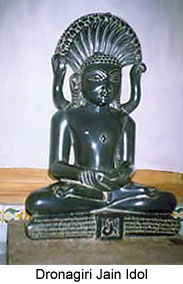
 Dronagiri is located 61 km south east of Gwalior, Madhya Pradesh on Delhi Mumbai railway route. Dronagiri is regarded as an ancient Nirvan Kshetra that has been mentioned in the ancient literature, ancient cave, ancient Jain temples and art of sculpture. Even Shri Pujyapad Swamy in Nirvan Bhakti, Acharya Harishen in Brihat Katha Kosh and in Nirvan Kand has mentioned Dronagiri as Nirvan Kshetra. One can see 84 gleaming white shrines by coming down the east-facing slope of a solitary hillock. It is believed that here King Nanganang Kumar, along with five-and-a-half crore of his followers, achieved nirvana.
Architecture of Jain Temples
There are 27 temples on the hill at Drongiri. The principal deity of the temple is Lord Adinatha. The idol is nearly 2 feet high and is white in colour. The idol is seated in a Padmansana posture. In Dronagiri Jain Temples one can see large ancient cave. It is believed that Shri Gurudatta and others had attained Moksha or Salvation. Later the place was visited by Charitra Chakravarti Acharya Shri Shanti Sagarji Maharaj who selected the spot for meditation and penance in the year V. S. 1929. According to the story of Gurudatta and other saints, the cave had served as the home for lions. Dronagiri also finds its mention in Aradhana Katha Kosh. A pair of foot image of Shri Gurudatta is installed in this cave.
There are several temples built in Dronagiri. The main temple that crowns the summit of Hasthinapur, has a colossal of a tirthankara image. Below this image a model of Mount Meru made of ceramic appears out over the cascade of whitewashed spires. It is regarded as the axial mountain that supports the cosmos. The courtyard of the temple serves as the place for conducting religious discussions by old Digambar monks. These monks preach and discuss with the pilgrims about religious matter. The monks always keep their distinctive yellow wooden water pots and peacock-feather whisks beside them. The monks roam about from one place to another naked for most of the year. Later they return back to their monasteries for a few months to preach and receive teachings.
There is a 200 years old big temple located here. Another beautiful temple about a century old and five small shrines are standing on different mounds in the forest, within a distance of 7 kilometers. The five Jain stupas have also made it a popular place.