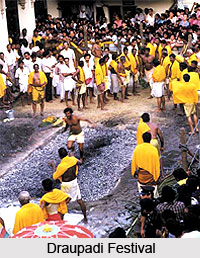
 Draupadi Cult in Folk Literature comprises an enormous number of plays. First, and most indispensable, is the group of plays that provide the basic skein of episodes that carry along the central Mahabharata story as it is related in the Villiparatam: that is, from the youths of the heroes to the end of the war. Most, but not all of these, are currently enacted at Draupadi festivals, and at many festivals particularly shorter ones it is only plays from this group that are included.
Second, there is a group of plays that enact episodes of Mahabharata folklore that have no basis in any classical version of the Mahabharata but are connected in one way or another with the Draupadi cult. Of those currently available, several are included in the Irattina Nayakar collection. When such dramas are performed at Draupadi festivals, they are included in small numbers.
A third group is concerned with classical Mahabharata themes that are not currently performed at Draupadi festivals. In festival terms, the material they cover is the province of the paratiyars. It may be that some of these dramas were originally composed for festival performance and had limited local runs or certain troupes that specialized in them. This seems most likely in cases where they have been published by some of the smaller presses that print the material as folk dramas, and where the episodes fall within the same temporal skein as the other dramas in the festival cycle.
Finally, a fourth group, consisting of a sort of fantasy Natakam literature about the heroes, inventing extra marriages for them, new offspring, new conflicts between them, and new demons for them to defeat, treats the classical epic only as a thematic cornucopia and has seemingly little to do with the ritual or mythical themes of the Draupadi cult. If these plays are performed at Draupadi festivals at all, it has surely been only as supplemental entertainment.
The composition and publication of the majority of the dramas enacted in the Draupadi cult would thus seem to reflect changing concepts about the role of author and public, and to a certain extent, this has clearly influenced the Draupadi festival repertoire itself. But it is arguable that this literary output has probably not dramatically changed the basic performance character of the Terukkuttu.
Most important, however, the printed plays provide next to no stage directions or indications as to the use of props. No doubt actors are expected to improvise and readers to use their imaginations.