 Districts of Ladakh Division consist of the snow mountain deserts. These places are extremely less populated. Turtuk is the extreme village where the tourists are allowed to trek. Kargil District and Leh district are the important districts here.
Ladakh is a region in the state of Jammu and Kashmir of Northern India sandwiched between the Karakoram Mountain Range to the north and the Himalayan Mountain Range to the south. Ladakh is composed of the Leh District and Kargil District. Leh district is the second largest district of India, covering more than half the area of Jammu and Kashmir. The only two roads into the area from outside are the Zoji-La Pass and Kargil route from Srinagar District in the Kashmir Valley, and the high altitude Manali-Leh Highway from Himachal Pradesh.
The Manali-Leh road is open only from May or June to October or November, when snow is cleared from several passes. The Srinagar-Leh road is open from April or May to November or December, and is generally blocked by snow throughout the winter only at Zoji La Pass.
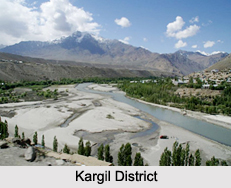
Kargil District
Kargil District is a district of Ladakh division in Jammu and Kashmir. Kargil lies near the Line of Control facing the Pakistan-administered region of Gilgit-Baltistan to the north, the Kashmir and Jammu divisions to the west, and the Leh district of the Ladakh division to the east. Zanskar is part of Kargil district along with Suru, Wakha and Dras valleys.
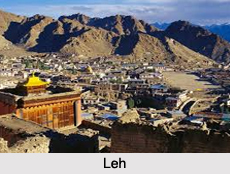
Leh District
Leh District is one of the two districts located in Ladakh, the other being the Kargil District to the west, in the state of Jammu and Kashmir. With an area of 45,110 square kilometers, it is the second largest district in the country in terms of area. It is bounded on the north by Ghanche District a small border with Xinjiang, China, via the Karakoram Pass which is part of the district. Aksai Chin and Tibet are to the east, Kargil district to the west, and Lahul and Spiti to the south. The district headquarters is based in Leh. It lies between 32 to 36 degree north latitude and 75 to 80 degree east longitude.
Tourism in Ladakh
Tourism in Ladakh includes the places of tourist interest like Leh, Dras, Razi Khar, Suru valley, Kargil, Zanskar, Zangla, Rangdum, Padum, Phukthal, Sani Monastery, Stongdey, Shayok Valley, Sankoo, Salt Valley. Popular treks are Manali to Ladakh, the Nubra valley, Pangong Tso, Tso Moriri Lake, Indus Valley, Markha valley, Ladakh monastery trek, South Zangskar, Trans-Zangskar Expedition, Spiti to Ladakh, Spiti to Pitok to Hemis, Rupshu, the Great Salt lake, Chadar Ice trek, Padum-Phuktal, Padam to Darcha, Panikhar to Heniskot, Padum to Manali, Lamayuru-Martselang, Lamayuru - Alchi, Kala Pattar trek and Pahal.