Dholpur district
Dholpur district of Rajasthan is well known for its red sandstone.

Share this Article:

Introduction

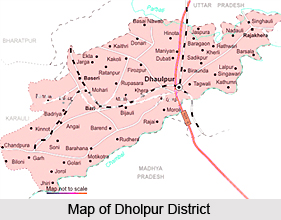
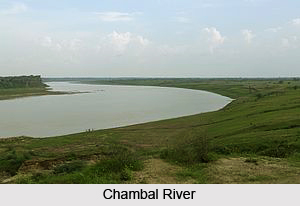
Dholpur district, RajasthanDholpur district is a prominent district of Rajasthan and its administrative headquarters is at Dholpur. Surrounded by Agra district of Uttar Pradesh in the north east, Morena District of Madhya Pradesh in the south, Karauli District of Rajasthan in the west, and Bharatpur District of Rajasthan in the northwest it covers a total area of 3,084sq. Km. The Chambal River flows through the southern boundary of the district. It receives an annual rainfall of 67 cm. and is one of the hottest places in Rajasthan. The nearest airport is at Agra.

According to the 2001 census report, the population of the district is 982, 815 inhabitants with a population density of 324 persons per sq. km. The literacy rate of the town is 60.1%. The male literacy rate is 75.1% and the female literacy rate is 41.8%. For administrative purposes the district is divided into four subdivisions Dholpur, Badi, Rajakhera, and Basedi, and five tehsils, Dholpur, Badi, Rajakhera, Basedi, and Saipau.

Primarily thriving on agriculture the main crops grown here are bajra, paddy, sugarcane, wheat, barley, pulses, red chilies and guar seed.

Laswari, Shergarh Fort constructed by Sher Shah Suri, Talab Shahi (a historic lake known forits scenic beauty 40 km. from Dholpur), Khanpur Mahal, the pleasure house of Shahjahan, Shiva Temple, Ramsagar Wildlife Sanctuary and Van Vihar Wildlife Sanctuary are the prime attractions of the district. Machchhkund, an ancient sacred place around 8 km. from Dholpur is a major excursion site in the neighbourhood.

History of Dholpur District

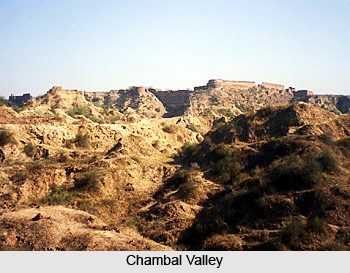
History of Dholpur DistrictDholpur district, according to the epics, was initially known as Dhawalgiri and later on Dhaulagir, and now as Dholpur. Before the battle of Mahabharata this whole area was under the Yadavas. The key to the ancient history of Dholpur is the ruins of strong fort which is situated on the bank of river Chambal.
During the second phase of ancient history, the ruins of Mahabharata period could be seen and around the temple of Muchukund ji. According to the Shastras Muchukund was a very illustrious king before Krishna. During the war between Devtas and Danavas, King Muchukund sided with the devtas and was instrumental in their victory. Indra was so pleased that he asked Muchukund to have a boon. Muchukund was so tired that he asked Indra to allow him to sleep peacefully and if anyone should dare to wake him up, Muchukund`s angry gaze would burn him to ashes. Mahabharata reveals that during one of the battles with the demons Krishna ran away to save his life from one of the demons and came to the spot where Muchukund was sleeping. He put his pitamber on the sleeping Muchukund. The demon thinking him to be Krishna woke him up, and thus the demon was burnt to ashes, and thus the life of Krishna was saved. The event took place, in a spot very near to the Muchukund Ji`s temple, where the ruins of old palaces still exist. The appearance of these, however does not seem to be that old.

The history of Stone Age dates back to the Stone Age. The antiquities found in Dholpur can be datable to pre-Gupta period, and the site remained under the occupation up to the late medieval period.

Brahmnism and Jainism both were prevailing in the society during the early medieval period. The discoveries of Naga and Nagis figures from Dholpur put the considerable influence of Nagavansies of Padamvaties over this area. They were succeeded by Guptas as evidences reported from the excavations at Donder Khera. The figures of Nagas and Nagis sculptures all belong to tenth to twelfth century A.D. An eleventh century panchayatana temple called as Jogni-Jogana situated near Sone-ka-Gurja is an important edifice of this period.


Economy of Dholpur District

Economy of Dholpur DistrictThere are three large scale industries in Dholpur district namely, the High-tech Precision Glass factory, Dholpur; Dholpur glass works Ltd., Dholpur and Rajasthan Explosives Limited Dholpur. The High-tech Precision Glass factory, Dholpur; Dholpur glass works Ltd., are public limited concerns. They went in to production in April 1964 with an authorized share capital of Rs. 50 and Rs. 10 Lacs respectively.
Dholpur Glass Works Ltd. was established under a special agreement with erstwhile Dholpur State as a proprietary concern in 1943. Later in the year 1945, it was converted in to a public limited company. In the year 1956, it started manufacturing laboratory and hospital glass wares, as well as penicillin vials providing employment to the nearly 900 workers. The raw materials used are sand soda ash, borax, dolomite, feldspar, selenium, black powder etc.

During the last century Dholpur remained industrially backward. It mainly depended on agriculture and only a few cottage industries were in existence.

Quarrying of building stone was the only activity which provided employment to the comparatively large number of persons. Baroli, Bari, Baseri, Sarmathura were important places where building and millstone were quarried. These quarries have been famous for quality stone and have been worked on for several centuries. None of industries were properly organized. They were mostly cotton industries subsisting on the patronage of village communities. People, however, started using imported machine-made goods from the neighboring commercial and industrial centers such as Agra, Mathura, Delhi and Gwalior. The better and cheaper mill-made cloth adversely affected the handloom, spinning, dyeing and weavings. Bangles made of transparent glass lured the women folk to give up their crude glass and lac bangles, further more the monopoly of arts and crafts by individuals meant that the skills died with them, in the absence of regular, organized inheritance of such skills.

Dholpur district has a vast area, full of rocks, especially the Dholpur and Rajakhera Part of the Chambal valley is covered by Kachhar. Masonary stones, concrete, sandstone and lime stones are found in plenty in the area. Glass sand is produced from unconsolidated weathered sandstone and is sold mainly to glass manufactures.

Quarrying work is mainly done by hand with the help of chisel, hammer, iron bars and the over-burden is blasted with gun powder. Sandstone areas are leased out to private sector under the Rajasthan mines and mineral concession rules 1959.

Many persons are engaged in weaving, pottery, leather tanning, carpentry, black smithy, rope making etc. In rural areas of the district Rajasthan Khadi and Village industries board, provide guidance and financial help. There are other agencies too, to encourage such units. Village ghanis, Moodha industry, sugar cane-crushers, Khas Distillation are the other units, which keep persons employed and provide opportunity to local crafts men and artists to come forward.


Share this Article:

More Articles in States of India


East Indian States
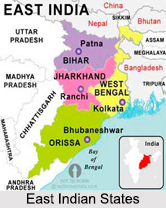
East Indian States comprises of Bihar, Jharkhand, West Bengal, Odisha and also the Union Territory of Andaman and Nicobar Islands. It defines the cultural heritage, rich historical background and the linguistic unity.
Erode District
Erode District is one of the districts in the state of Tamil Nadu. The district of Erode is having a land-locked area with no sea coast.
Purnia District in Bihar
Purnia District is located in Bihar and extends from River Ganga to Nepal. The district has a rich Hindu history and glorious past.
South Delhi District
South Delhi District is the third largest district of Delhi as far as its area is concerned. South Delhi District is known for its economic, historical, cultural and social significance.
North Indian States
North Indian States formed the cultural and religious unity in spite of having many foreign invasion and the political disturbances from the early era till the British gained supremacy in Indian sub continent.
Kendujhar District
Kendujhar District, spread over an area of 8,240 sq kms, is as varied as the whole of Orissa with waterfalls roaring gorges, mountains and minerals. The manifold expressions of nature in Kendujhar District are considered as unique.
Hooghly district
Hooghly District along the bank of the river Hooghly is one of the principal trading ports of West Bengal.
Districts of South Tamil Nadu
Districts of South Tamil Nadu consist of many tourism destinations like archaeological sites and the history of Pandyas and Cholas. Considering their proximity to the sea, many districts also boast of serene beaches and coastal beauty.
Flora of Arunachal Pradesh
Flora of Arunachal Pradesh includes infinite species and is a subject of great interests for the botanists.
Districts of South Gujarat
Districts of South Gujarat are the epicenter of Jain pilgrimages and the early Hindu kingdoms.
North West States of India
North West States of India consist of three states, which are Rajasthan, Punjab and Haryana. All of them are culturally and traditionally diverse and they have been ruled by different dynasties in historical time.
Geography Of Chittoor District
Geography of Chittoor district is spread along the topography of the land which is divided into two natural divisions; Chittoor has a dry and healthy climate.
Districts of North Rajasthan
District of Northern part of Rajasthan is dotted with ancient forts and medieval villages.
Districts of North Odisha
District of North Odisha has Bengal boundary and shares the same culture. These are reachable if one pays a weekend visit to Digha.
Districts of West Bihar
Districts of West Bihar is comprised of medieval monuments that were built by the different governors of Mughal era.
Districts of South Haryana
Districts of South Haryana consists of many cities of industrial excellence. These districts are dotted with popular tourism destinations.
Medieval History of Assam
Medieval history of Assam narrates the advent and rule of a number of kingdoms in the region. The prominent dynasties of the kingdom left an everlasting imprint on the socio cultural heritage of India.
Geography of Meghalaya
The suitable climate, highland plateaus, rivers and the flora and fauna together forms the geography of Meghalaya.
Districts of Rayalaseema
Districts of Rayalaseema in Andhra Pradesh state has urban population and rural settlements as well.
Districts of South Punjab
Districts of Southern part of Punjab depict medieval history of Punjab and the rise of Sikhs.