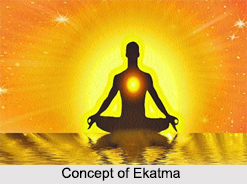
 Concept of Ekatma means oneness, and is said to be the true meaning of love. Ekatma means complete merger with the beloved and the end of dual existence. There is no scope in love for the separate existence of the lover and the beloved. As soon as the feeling of duality between the Master and the disciple vanishes, one starts seeing His manifestation everywhere in the entire universe. Selfless love gradually turns into devotion, which makes one identical to one`s beloved. The disciple (the lover), however, is imperfect, and, therefore, it is the Master (the beloved), who being perfect, merges with the disciple and takes him on the path of love. It is for this reason that the Sufis love their Master the most. Their love for the Master lifts them to a state of bliss and presence in the heart of their beloved.
Love of God is given to all since it is He who has given birth to all. The very fact that something exists is a manifestation of His love. The Sufis consider human beings to be the best creation of the God and that the man has the highest place in His creation. But the perfection of human beings lies in becoming a `complete man` (Insan ul kamil). The Qualities and Attributes of the Almighty reflect in a complete man. All creatures endeavour to evolve as complete man, as one could realise the Supreme Being only after that. The journey of all creatures started from the Supreme Being and will end with reaching back to Him. The period spent in the process is the `period of being` (Dauran e Wajood). It is, therefore, not possible that His highest creation, the man, is devoid of love. This love, however, does not surface till the heart is cleaned and it reflects that love like a mirror reflects the light of the sun.
Initially the Sufi wayfarers considered it necessary to live a life of ascetics and hermits, with immense fear of God. They, therefore, spent their time in meditation and in the remembrance of the God to overcome their ego. Gradually, however, they realised that ego could be sacrificed only through love. Without love one cannot stand firmly for long. With the complete surrender of the ego one acquires the spiritual knowledge that his essence is the essence of God i.e. cessation of the duality and that his reality is nothing but the Reflection of the God. With this realisation one reaches the state of Unity i.e. the state of Oneness. In this state there is no difference between the love, faith and enlightenment. This is the true knowledge. When this realisation dawns one`s self exists no more. In unity with God what exists is only the Reality of the God and one sees the existence of God alone in all beings.