 Complex of St. John Church gives the appropriate description of the British architectural style. St John`s Church was constructed on an old graveyard, so the compound houses a number of tombs and memorials, but only a few dates back to the date of construction of the church. The old graves and the monuments of St John"s Church are Job Charnock"s Mausoleum, Black Hole of Calcutta Monument, Second Rohilla War Memorial and the graves of Lady Canning, Lord Braboune and the judges of Supreme Court of India at that time, which is now the Calcutta High Court.
Job Charnock"s Mausoleum
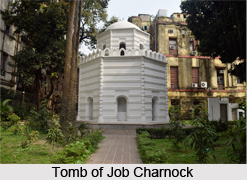
Job Charnock"s Mausoleum is located at the back northwest corner of St John`s Church grounds. There is a small gated cemetery part-paved with 18th century grave stones. The centrepiece of this area is a hollow thick-walled octagonal cenotaph on whose inner wall one can find the grave of Job Charnock.
 He died in 1693, just three years after his third visit to what would become Calcutta. The grave gives his date of demise as January 1692. The octagonal Moorish style tomb was erected by son in law of Job Charnock, Charles Ayer. Job Charnock"s Mausoleum was built of stones brought all the way from Pallavaram near Chennai, which later came out to be known as Charnockite.
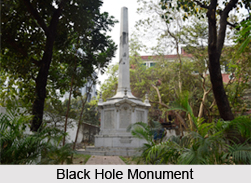
Black Hole of Calcutta Monument
Holwell, British general had erected a tablet on the site of the `Black Hole` to commemorate the victims but, at some point before 1822. At the apex of the Indian independence movement, the presence of this monument in Kolkata was turned into a nationalist cause calibre. Black Hole of Calcutta event is a controversial part of Indian history; for others it was an atrocity that befell its victims.
 According to one British survivor (John Holwell), during the siege of Calcutta Siraj ud daulah took 146 prisoners and confined them in a room measuring 14 feet by 8 feet and locked them up overnight. Only 23 survived: the remaining 123 perished of suffocation and heat stroke.
Rohilla War Memorial
The First and Second Rohilla War was fought between the Rohillas and the Nawab of Oudh, with the British backing the later. Rohillas are a branch of the Pashtun tribe of the Pakistan and Afghanistan border. Some of the Rohillas settled in the Oudah region and soon a conflict began between the Rohillas and the Nawab of Oudh, Shuja - ud - Daula. This resulted in Rohilla War.
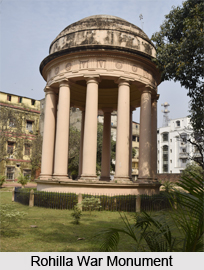
 The British backed the Nawab of Oudh and in January 1774 the Rohilla chief Hafez Ruhmet was killed resulting in the defeat of the Rohillas. Rohilla Memorial at the St. John"s Church compound consists of a circular dome supported by 12 pillars. The memorial contains a plaque with the names of several British Military Officers, killed in the Rohilla War.
Lady Canning`s Memorial
Charlotte Canning was the wife of Charles Canning the Governor General and Viceroy of India. She died of malaria and was buried in Barrackpore a memorial was also constructed in the St. John"s Church graveyard. Lady Canning"s name have been made immortal by the famous sweet maker Bhim Nag, who specially designed the sweet Pantua in her honour and named it "Ladykeni".
Francis (Begum) Johnson"s Grave
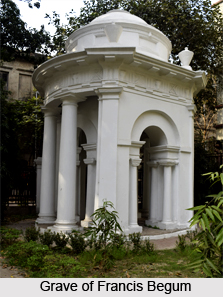
Francis (Begum) Johnson"s grave is located at the far end of the St. John"s Church complex and next to Job Chranok"s tomb. It lies in the circular temple-like tomb of Francis Johnson (1725-1812). The grave stone inside the grave is no less interesting than the grave itself.