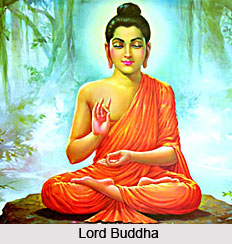
 Company of saintly people according to Lord Buddha is an important criterion to achieve Nirvana and he had explained the benefits of a good company in his Philosophy of Action in Dhammapada. Buddha had insisted on the company of the wise and the saintly. He said that it is better to be alone than in a bad company for an individual. He had said, "If a man can find a prudent companion who associates with him, who leads a pious life and is steady, he may live with him delighted and thoughtful, overcoming all obstacles."
Dhammapada has given a lot of emphasis on the essence of a proper company. It has said that there should not be any fellowship with a fool. A man must find his company either among his equals or in somebody who is better than himself. According to Dhammapada one should follow the steady, the intelligent, the learned, the much enduring, the dutiful, the noble, the good and the wise. It has said one should try to seek the company of the wise man, who points out ones faults and reproves, who shows one what needs to be avoided. An individual should value such a person who reveals the real treasures of life. In fact such an association will prove beneficial to him.
Dhammapada in this section has said that an individual, who advises, teaches, instructs and dissuades people from wrong paths he becomes pleasing to the good and unpleasing to the wicked. It is best for a person to associate with such persons instead of associating with those who are wicked and evil-minded. Lord Buddha in this section of Dhammapada had said that it is far better to pay homage to a worthy individual. By worthy it was meant an individual who is noble and upright.
It has been said that four blessings of long life, beauty, happiness and strength are bestowed upon those who constantly practice reverence and respect to others. It propagates the philosophy that just as a Brahmana reveres the sacrificial fire similarly should a man revere his Teacher from whom he has received the Enlightenment of life.
This section of the Dhammapada ends saying that it is difficult to leave the world to become an ascetic. It is difficult to enjoy the world; to live in a house which is not worth living. It is also painful to be in the company of unsuitable people. Difficult and painful is the life of a wanderer. Hence it is desired that no one should tumble into the clutches of suffering.
Finally it has concluded saying that a man full of faith, virtue, wealth and glory is respected wherever he goes and at the same time it is virtuous people who shine from far like the Himalayas. On the contrary vicious people vanish unseen like arrows shot by night.