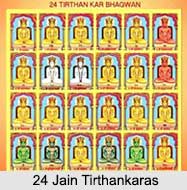
 Jain Tirthankara is the personage who shows the path to liberation or Moksha. They are the Spiritual Masters who show right path to living beings. These individuals are referred to as "Jina", meaning persons who have subjugated their human weaknesses. Jinas are the creators of spirituality. The Jains regard their Tirthankaras as supreme deities. There are some common features among the 24 Jain Tirthankaras. They are as follow:
1. Position in Navkara Mantra - All the Tirthankaras occupy first place in Navkara Mantra even before Siddhas, as they are our immediate guide in the form of human beings who show the path of liberation.
2. Numbers - As per Jainism, in each half time-cycle there are 24 Tirthankaras only.
3. Kalyanakas - Jains celebrate five auspicious events of the life of a Tirthankara, known as "Kalyanakas". They are: a) Chyavana Kalyanaka - A Tirthankara"s soul departs from the last life, and is conceived in the mother"s womb.
b) Janma Kalyanaka - A Tirthankara"s soul is born.
c) Diksha Kalyanaka - A Tirthankara"s soul gives up all the worldly possessions and becomes a Monk/ Nun.
d) Kevaljnana Kalyanaka - A Tirthankara"s soul attains the Kevaljnana or Absolute Knowledge.
e) Nirvana Kalyanaka - A Tirthankara"s soul is liberated from this worldly physical existence forever and becomes a Siddha.
4. Dreams - There are total 72 auspicious dreams, out of which 14 or 16 are clearly seen by the mothers of Tirthankaras.
5. Symbols - The emblems or symbols associated with the Tirthankaras are drawn mostly from animal and vegetative life. These symbols suggest sublimation of the qualities possessed by chosen animals and vegetative forms.
6. Knowledge - A Tirthankara`s soul, while even in mother`s womb, has three types of knowledge, namely Mati Jnana, Shrut Jnana and Avadhi Jnana. When a Tirthankara renounces the worldly life, he attains Manahparyaya Jnana, the fourth type of the knowledge and finally after annihilation of Ghati karmas he attains Kevaljnana, the fifth supreme and Absolute Knowledge.
7. Swayambuddha - They are self enlightened, hence they are not trained by a Guru.
8. Body - Their body is made up of Param Audarik Pudgal, bright crystalline atoms.
9. Twelve Virtues - It includes 4 main Atishayas and 8 Pratiharyas.